Subcontractor insurance: cover when you bring others on site

The plasterers have been on site for three weeks when one of their workers drops a scaffold plank four storeys onto the pavement below. Nobody is killed, but a delivery driver breaks his wrist, a windscreen shatters, and the principal contractor gets the call, not the plastering subcontractor. The principal's name is on the hoarding. The principal signed the lease on the site. Whatever the plastering crew's policy says, the client holding the contract is the one standing in the meeting with the attorney. Liability on a construction site follows the structure of authority, not the structure of invoices, and most contractors learn this the hard way.
What is subcontractor insurance?
Subcontractor insurance is the collective term for the liability, indemnity, and works cover applying when a specialist contractor carries out part of a project under the authority of a main or principal contractor. It addresses who pays when a subcontractor's actions cause damage to the works, injury to a third party, or a financial loss to the project. The cover may sit with the main contractor, with the subcontractor, or with both, depending on how the contract and the policy schedules are structured.
Key Takeaways
- A main contractor's public liability policy doesn't automatically extend to cover acts or omissions by independent subcontractors working under a separate agreement.
- Most project contracts and government procurement documents require subcontractors to hold their own liability insurance as a condition of being engaged.
- Where a subcontractor's negligence causes a loss, the injured party often claims against the main contractor first, since the main contractor is the visible, contractually responsible party.
- A contractors all risk policy covering the works typically includes cover for damage caused during the sub-contracted portion, but the excess, the subrogation clause, and the named-insured wording all need to be checked.
- SASRIA's construction risks cover responds to damage caused by political violence, riots, and strikes, but it must be purchased separately from the standard contractors all risk policy and sits alongside it.
- Professional indemnity cover for design-and-build subcontractors is a separate class again, and many subs carrying liability cover carry no indemnity cover for the advice or design element of their work.
Why the main contractor holds the risk even when the sub causes the damage

The most common misunderstanding on South African construction sites is signing a subcontract agreement transfers the risk. It transfers the work. Risk transfers only to the extent the sub's own insurance responds, and on the day a claim lands, that is rarely the first question anyone asks. The first question is whose name is on the principal agreement.
South African contract law treats the principal contractor as the party in control of the site. When a subcontractor's worker is injured, or when a subcontractor's work causes damage to an adjoining property, the party with primary site authority is the first respondent. The subcontractor may ultimately carry the liability, but that resolution happens after the claim, after the legal process, and often after the main contractor has already incurred legal costs defending a position caused by the sub's negligence.
Government procurement documents reflect this structure consistently. Several public-sector tender conditions in South Africa explicitly require the principal contractor to ensure subcontractors hold appropriate insurance cover throughout the engagement. The obligation to verify doesn't evaporate because the sub assured you verbally the cover was in place.
What the subcontractor's own policy must cover
The cleanest arrangement is one where each party holds the cover appropriate to their role and the contract specifies the minimum. In practice, the gap between what the contract requires and what the sub has actually placed is where most disputes begin.
A subcontractor working on a commercial project typically needs, at minimum, public liability insurance covering third-party bodily injury and property damage arising from their own operations. For a subcontractor with employees on site, the Compensation for Occupational Injuries and Diseases Act (COIDA, the statutory fund all South African employers must register with) covers their workers for injury on duty, but it doesn't cover damage the sub's workers cause to others or to the works.
Where the subcontractor is also providing a design element, a specification, or technical advice, a standard public liability policy doesn't respond to a claim arising from a design error. That exposure sits in professional indemnity cover, and most public sector engagements now set a minimum threshold for it. One set of public procurement terms reviewed for contracts in the region of R2 million requires the successful party to hold professional indemnity cover as a condition of contracting. The figure varies by project value; the principle is consistent.
How the contractors all risk policy fits the subcontractor picture
A contractors all risk policy, often called a CAR policy, is the broad works insurance covering physical damage to the contract works, the materials on site, and temporary structures during the construction period. It is the policy paying when the half-built structure is damaged by a storm, when the excavation collapses, or when materials stored on site are stolen. On a project where a main contractor has placed a CAR policy covering all parties, the subcontractor's work is typically included in the definition of the works, and physical damage to that portion of the works is covered under the main policy.
The difficulty is not every CAR policy automatically names subcontractors as insured parties. Some wordings restrict cover to the named insured and require an endorsement (a specific addition to the policy agreed between the insurer and the broker) to extend cover to sub-contractors working on the project. Where no endorsement exists, a sub causing damage to the works may find the main CAR policy declines the claim for that portion on the grounds the sub wasn't an insured party under the policy. Once the loss adjuster has the wording in front of them, this isn't a grey area. It is arithmetic.
Your responsibility, before the first subcontractor sets foot on site, is to confirm with your broker whether the CAR policy extends to subcontractors and, if not, whether the sub is expected to place their own works cover. Both approaches are workable. Assuming the answer without checking is not.
SASRIA cover and what happens when a subcontractor is on site during a riot or strike
South Africa's construction sites are exposed to political violence, labour unrest, and strike action in ways most other insured risks are not. The standard CAR policy, like most South African property policies, excludes damage caused by riot, strike, civil commotion, and public disorder. That exposure sits with SASRIA, the state-owned special-risk insurer, which is the only insurer in South Africa authorised to cover these perils for most classes of risk.
SASRIA's construction risks cover is purchased as an add-on alongside the main CAR policy. The standard insurer collects the SASRIA premium and passes it across; SASRIA pays claims in that class. Where a subcontractor is on site when strike-related damage occurs, the question of whether the SASRIA policy responds depends on whether the sub's portion of the works is covered under the main project SASRIA schedule, or whether the sub was expected to arrange their own SASRIA cover separately.
The practical consequence of this gap isn't theoretical. A sub-contractor whose welding equipment and materials are destroyed in a site invasion during a labour dispute, and who holds no SASRIA cover of their own, finds the standard CAR policy declines on the political violence exclusion and the SASRIA policy declines because they weren't a named or scheduled party. The loss lands on whoever can least afford it.
The liability chain when a subcontractor causes injury or property damage
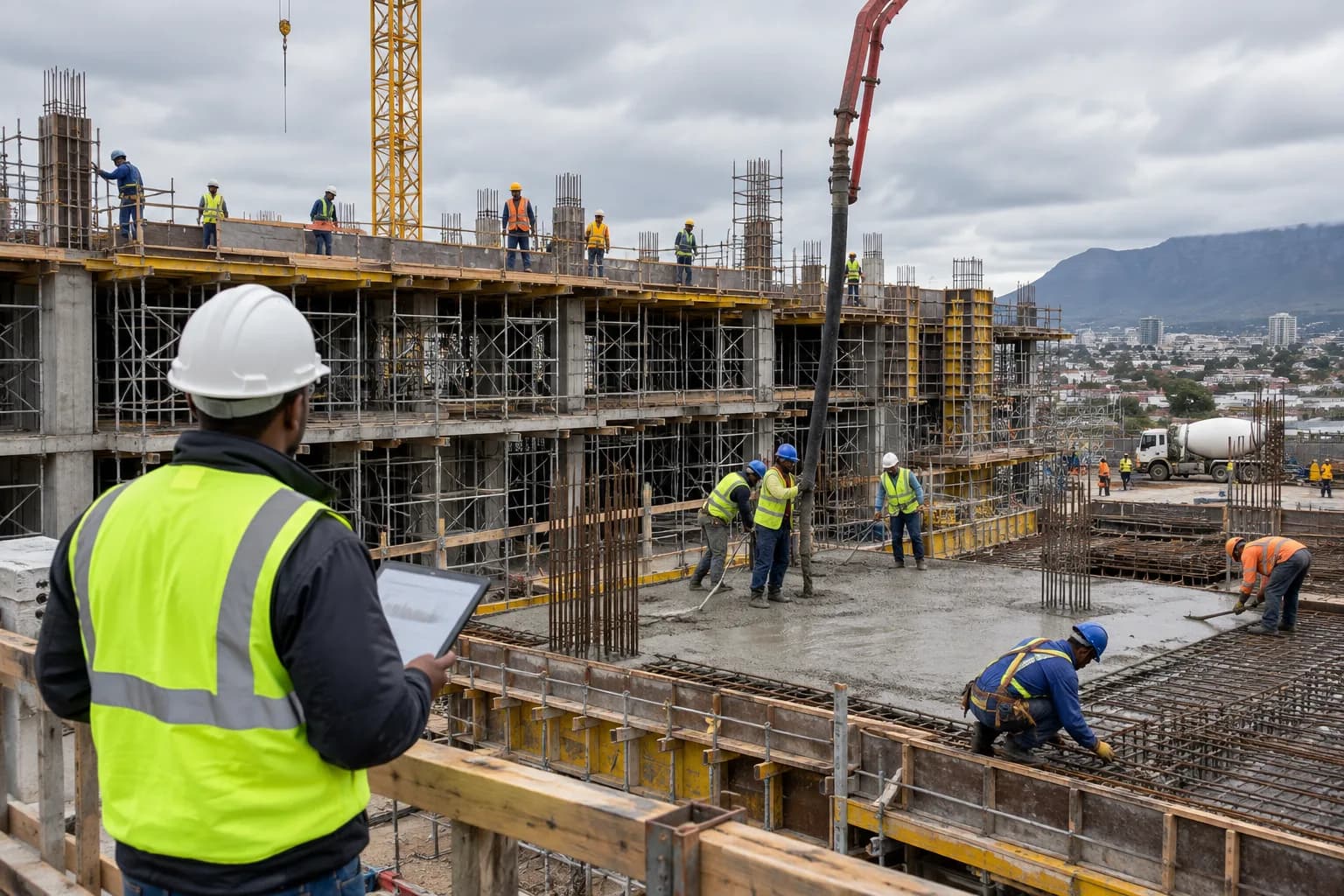
When a sub's worker drops a tool, drives a forklift into a wall, or leaves an excavation unmarked and a member of the public falls in, the liability chain runs through several parties simultaneously. The injured party (or their attorney) will typically claim against the principal contractor, the main contractor, and the subcontractor, in whichever combination offers the fastest and most certain recovery. South African law doesn't require the injured party to establish whose negligence was the primary cause before suing; they can pursue all parties and let the courts apportion.
The following table sets out the policies typically responding at each level, along with the exposure falling through where cover is absent or incorrectly structured.
Cover responsibilities in a typical subcontracted construction project
| Party | Policy responding | Common gap |
|---|---|---|
| Principal / client | Not typically liable unless they directed the work | May still face reputational and delay costs |
| Main contractor | Public liability (own acts); CAR policy (works damage) | Sub's acts may fall outside main policy scope |
| Subcontractor | Own public liability policy | Policy may exclude acts on third-party sites |
| Workers (COIDA) | Compensation Fund for their own injuries | Damage caused to others is not covered by COIDA |
| Design sub | Professional indemnity for design errors | Standard public liability does not cover design advice |
The insurer's right of subrogation means once a claim is paid, the insurer stands in the shoes of the insured and pursues recovery against whoever caused the loss. If the main contractor's public liability policy pays out a claim caused by the sub's negligence, the insurer will typically pursue the sub for recovery. A subcontractor with no policy, or with a policy excluding third-party site work, has no cover to respond to that subrogated claim. The cost lands personally on the sub's business.
What the contract must say before work starts
The single most effective risk management step available to a main contractor is a written subcontract specifying the insurance requirements before any work begins. A verbal assurance from a sub that they "have insurance" isn't cover. Cover is what the wording says, and a subcontractor holding a domestic public liability policy (the class designed for a sole trader working on residential jobs) may have no cover at all for work on a commercial construction site.
A well-drafted subcontract specifies the minimum sum insured for public liability (typically R5 million or more for a commercial project, though the appropriate figure depends on the scope and value of the works), whether professional indemnity is required and at what limit, confirmation of SASRIA cover where the project is exposed to unrest risk, and a requirement the sub provides a certificate of insurance before mobilising. The contract should also specify whether the sub is covered under the main CAR policy or must place their own works cover.
The verification step isn't optional. A certificate of insurance from a subcontractor confirms a policy existed on the date the certificate was issued. It doesn't confirm the policy was renewed, the premium was paid, or the cover is adequate for the specific scope of work. Asking to see the current schedule, not only the certificate, is the standard your broker should recommend and the standard government procurement increasingly requires.
When the subcontractor's cover fails at claim time
Cover fails at claim time for a small number of recurring reasons, and understanding them before the loss is considerably cheaper than understanding them after. The most common failure modes are: the sub held a personal lines policy rather than a commercial one; the policy excluded work on third-party sites; the sub's sum insured was too low to meet the claim; the policy had lapsed for non-payment; or the sub's activities fell outside the trade or occupation description in their policy.
That last point catches more subcontractors than most expect. A policy describing the insured's occupation as "general painting and decorating" may not respond when the sub was applying specialist fire-retardant coating to structural steelwork. Occupation descriptions in liability policies are consequential in the same way cargo descriptions are in a goods-in-transit policy: if what you're doing when the loss occurs doesn't match what the policy says you do, the insurer has grounds to decline.
The cost of fixing this before a claim is a conversation with a broker. The cost of discovering it afterward is a claim paying nothing, a legal process costing something, and a project relationship costing the rest.
Cover sits where the contract says it sits

A construction project in Johannesburg with four subcontractors on site simultaneously has the structural simplicity of a lease-renewal negotiation between four landlords who each believe they own the building. The liability chain is long, cover can sit at multiple levels, and the gap between what each party believes is in place and what a loss adjuster confirms exists is, in our experience, reliably wider than anyone thought when they signed the subcontract. None of that is inevitable. It is a documentation problem with a documentation solution, and that solution is considerably less interesting to work through than a claim.
You shouldn't have to find out at the claim stage which policy responds and whose doesn't. With Mont Blanc Financial Services you won't.
Contact Mont Blanc Financial Services to review your subcontractor insurance structure, check your CAR policy extends correctly to third-party workers on site, and confirm every party on your project holds the cover the contract requires before anyone starts work.
The questions below cover what contractors and subcontractors ask most when they start working through the liability structure. If your situation is more specific than a general answer can handle, a broker conversation is the faster route to a useful answer.
Frequently Asked Questions
Do subcontractors need their own subcontractor insurance?
Yes, in almost every commercial construction context, a subcontractor needs their own insurance, and most well-drafted subcontracts make this a condition of engagement. A main contractor's public liability policy typically covers the main contractor's own acts and omissions. It doesn't automatically cover the acts of an independent subcontractor working under a separate agreement.
The minimum a subcontractor generally needs is public liability cover for third-party bodily injury and property damage arising from their operations. If their scope includes design, specification, or technical advice, they also need professional indemnity cover, since a standard public liability policy excludes claims arising from design errors. Where they have employees on site, COIDA registration is a statutory requirement for South African employers, though COIDA covers their workers for injury on duty, not damage those workers cause to others.
Public-sector tenders are explicit about where responsibility sits. A Competition Commission tender for insurance broker services, for example, requires the appointed service provider to hold adequate professional indemnity cover and makes it responsible for the work of any subcontractors it brings in. Both carry an obligation: the sub to hold appropriate cover for its own work, the main contractor to hold its own and to verify the sub's.

Nicola Iozzo
Founder & CEO, Mont Blanc Financial Services
Nicola has spent his career reading the policy wording most people skip, and writes here so you don't discover at claim stage what page 14 meant.
This blog is here to inform, not advise. Think of it as a guidebook, not a contract. For decisions affecting your world, have a chat with your broker or financial professional.
Mont Blanc Financial Services (PTY) Ltd. is an authorised financial services provider. FSP 8271