SASRIA Explained
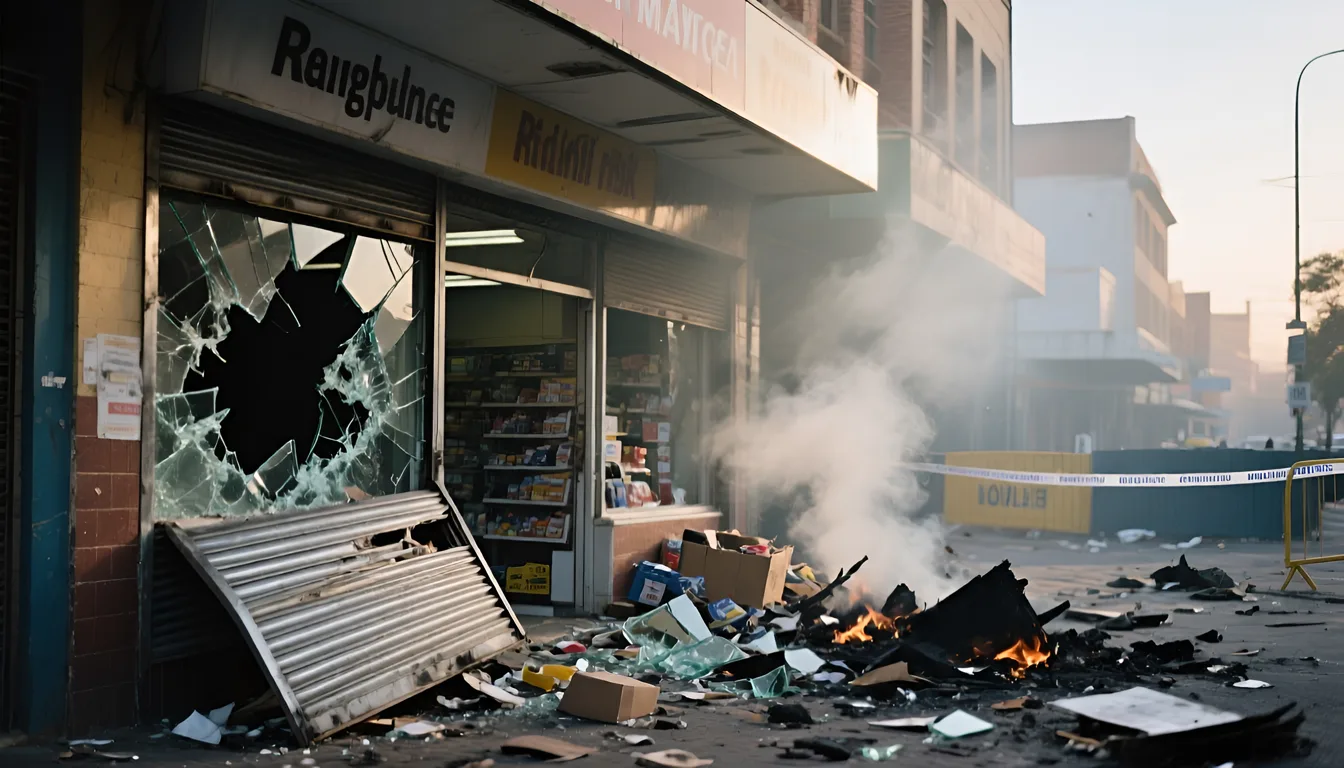
Unrest damage looks no different from fire or vandalism, but insurance treats it differently by design. Standard commercial policies exclude loss from riot, strike, and civil commotion, so a business whose stock is looted or whose premises burn during disorder can find its ordinary cover silent. The exclusion is deliberate, not an oversight. SASRIA exists to fill exactly that space, and the businesses caught out are usually those who never confirmed the cover was attached.
What is SASRIA insurance in South Africa?
SASRIA is a state-owned insurer that covers physical damage caused by riot, strike, public disorder, and civil commotion in South Africa, risks private insurers exclude from standard cover. It does not replace commercial insurance or issue full policies of its own; it attaches alongside an existing policy and responds only to unrest-related damage that has been correctly covered.
Key Takeaways
- SASRIA is a state-owned insurer covering physical damage from riot, strike, public disorder, and civil commotion, which standard policies exclude.
- Standard commercial cover excludes civil unrest because such losses arrive together in concentrated events that ordinary insurance is not structured to absorb.
- SASRIA does not replace commercial insurance; it attaches alongside an existing policy and responds only to unrest-related damage.
- Cover must be correctly attached to respond, so a business assuming it is automatic can find it was never in place.
- SASRIA can extend to vehicles and goods in transit, not only fixed property, where the relevant cover is arranged.
- Specific SASRIA limits and sub-limits change periodically and should be confirmed against the current schedule.
What Is SASRIA
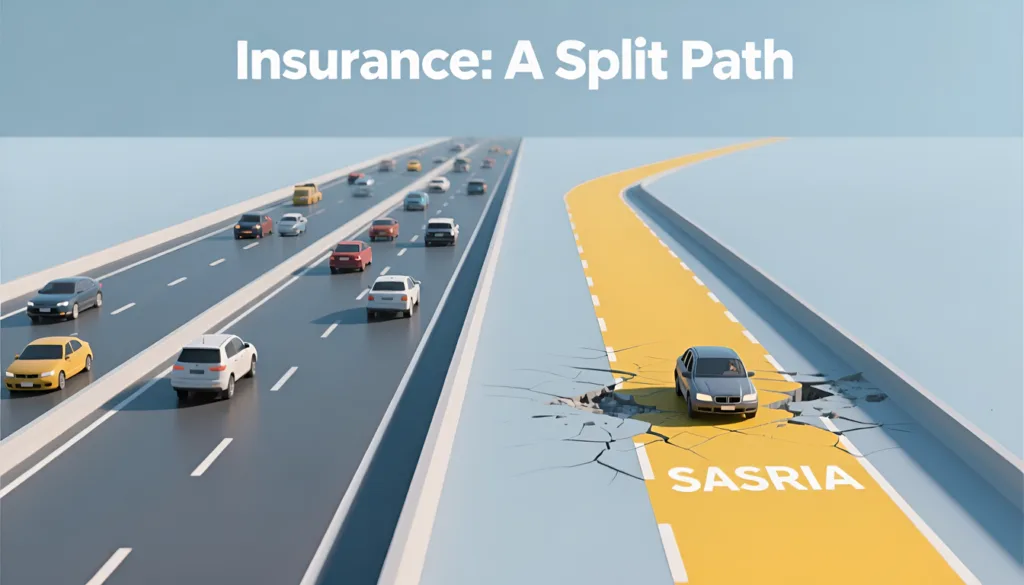
At first glance, insurance looks like a single road. Loss happens, cover responds, and traffic keeps moving. Unrest changes that expectation. It does not travel safely in the same space.
SASRIA operates in a narrow, clearly marked lane. It responds only to physical damage caused by riot, strike, public disorder, or civil commotion. Everything else continues on the main road, unchanged.
This separation explains why SASRIA does not replace commercial insurance and does not issue full policies of its own. It attaches where the road changes, and only there. Once this layout is visible, the limits feel deliberate rather than confusing, which leads directly into why standard insurance draws its boundaries where it does.
Why Standard Insurance Excludes Civil Unrest
Insurance is built to carry ordinary traffic. Most losses arrive one at a time, spread across places and over time, and the structure is designed to hold under that pattern. For years, it does.
Civil unrest changes the load all at once. Losses arrive together, in the same areas, and in numbers no ordinary structure is built to support. When too much pressure arrives at the same moment, the system bends in ways it was never designed to manage.
This is why riot, strike, and civil commotion are excluded from standard insurance policies. The exclusion is not a judgement call, and it is not selective. It is a structural safeguard. Without it, the entire system risks collapse under concentrated strain.
Once this limit is understood, the exclusion stops feeling like a refusal and starts reading like a boundary. That boundary explains why a separate mechanism is required, which leads directly to how SASRIA steps in where standard cover must step back.
What SASRIA Covers
During unrest, disruption spreads quickly. Trading slows. Access becomes uncertain. Loss feels immediate. Yet SASRIA does not respond to disruption. It responds to one condition only.
Think of SASRIA as a switch wired to physical damage. Until damage occurs, the switch stays off. Once damage happens as a result of riot, strike, public disorder, or civil commotion, the switch turns on and response becomes possible. Everything below follows that single trigger.
Business Property Damage
SASRIA can respond to damage to buildings, contents, machinery, and stock caused by looting, arson, or vandalism linked to unrest. Without physical damage, the switch does not activate.
Business Interruption Following Unrest
Business interruption may respond only after the switch has already been triggered. Physical damage must exist, and that damage must be insured under SASRIA, before any interruption loss can be considered.
Commercial Vehicles
Damage to vehicles caused by riot or civil commotion falls outside standard motor insurance unless SASRIA applies. When physical damage occurs during unrest and SASRIA is enabled on the motor section, the switch allows response.
Goods in Transit
Goods lost or damaged during transport as a direct result of unrest may fall within scope where SASRIA attaches to the goods in transit section. Again, damage is the trigger, not delay or disruption.
Once this pattern is clear, cover stops feeling unpredictable. Response follows the same rule across every section, which makes the limits easier to understand next.
What SASRIA Does Not Cover
When unrest unfolds, it can feel as though everything falls into the same category of loss. Trading stops. Access is blocked. Income drops. The experience blends together. SASRIA does not respond to loss in the same way.
SASRIA operates within a clearly drawn boundary. On one side sits physical damage caused by riot, strike, public disorder, or civil commotion. On the other side sits everything else. The line does not move, even when the impact feels severe.
Losses linked to reduced foot traffic, precautionary closure, or operational slowdown remain outside that boundary. Shutdowns taken to protect staff or property do not cross the line on their own. Losses tied to wider economic pressure or public restriction also remain outside scope. If no physical damage has occurred, the boundary has not been crossed.
This distinction often surprises people because the consequences feel similar. Income disappears either way. The difference lies in where the loss falls in relation to the line. SASRIA responds only on one side of it, and nowhere else.
Once this boundary is recognised, attention shifts from outcomes to structure. The next question becomes where SASRIA must sit inside a policy so that the line is crossed only when cover is meant to respond.
How SASRIA Attaches to Insurance Policies
A policy can look complete and still fail under pressure. From the outside, everything appears in place. Cover exists. Premiums are paid. Confidence follows. The weakness only appears when one component has never been fixed to the frame.
SASRIA attaches to a policy in the same way a structural component is bolted onto an existing build. It does not float. It does not cover the whole structure by default. It is fixed, deliberately, to specific sections. Property, motor, goods in transit, and business interruption each require their own attachment.
When the component is bolted on correctly, the structure responds as intended during unrest-related damage. When it is missing from a section, that section remains exposed, even if SASRIA appears elsewhere in the policy. A building may be enabled while vehicles are not. Stock may be covered while goods in transit are not. Each bolt changes how the structure performs.
This is why premiums appear separately and why SASRIA cannot be assumed across an entire policy. Each attachment changes how response is allowed to operate, section by section, under South Africa’s financial services regulatory framework. When this structure is recognised, outcomes stop appearing random. Claims move through a defined sequence instead, which is the next part to understand.
How SASRIA Claims Work
A claim enters the system carrying one question. Not how much was lost, but whether it is allowed to pass through. The answer does not arrive all at once.
The process works like a sequence of checkpoints. At the first point, loss adjusters confirm physical damage and identify the cause. If riot, strike, public disorder, or civil commotion sits at the source, the claim moves forward. If not, it stops there. No argument changes that outcome.
At the next point, the structure of the policy is examined. The relevant section must have SASRIA attached. Property, vehicles, goods in transit, or business interruption are checked individually. A claim can pass one checkpoint and fail another, depending on how the policy was built.
Once a claim clears each checkpoint, settlement follows familiar valuation rules. The steps feel slower during widespread unrest because many claims move through the same sequence at the same time. Volume stretches the process, not uncertainty.
When this sequence is visible, the claims process stops feeling arbitrary. Each outcome follows a step already in place. Understanding that sequence leads directly to the area most often misunderstood next, business interruption.
SASRIA and Business Interruption
When trading stops, attention moves quickly to income. Expenses continue. Staff still need support. The expectation is that the next part of the policy will take over and carry the loss forward.
Business interruption works like a relay. One runner cannot move until the baton has been handed over. In insurance terms, the baton is physical damage. Without it, the next stage does not begin.
If unrest forces a closure without damage, the baton never arrives. If damage occurs but SASRIA is not enabled on the affected section, the baton is dropped before the handover. Only when physical damage has occurred and SASRIA responds does business interruption step in and calculate loss.
Once this handover is understood, frustration eases. Business interruption does not ignore loss. It waits for the moment it is allowed to run. That same cause-based distinction continues into how vehicles are treated during unrest.
SASRIA and Commercial Vehicles
During unrest, vehicles draw attention whether they are moving or standing still. Damage often looks the same. Panels burn. Windows shatter. The difference appears later, when cause becomes more important than appearance.
Commercial vehicle cover during unrest works like a parked target. Movement does not decide the outcome. Use does not decide the outcome. The question is whether the damage arose from riot, strike, public disorder, or civil commotion.
Standard motor insurance responds to accidents. It does not respond to unrest. When SASRIA is enabled on the motor section and physical damage occurs during unrest, the target becomes insurable. When SASRIA is absent, the same damage remains outside scope.
This distinction often surprises policyholders because the vehicle feels no different after the event. The difference lies in how the damage was caused, not where or when it occurred. Once this pattern is clear, attention naturally shifts to the next exposed area during unrest, goods in transit.
SASRIA and Goods in Transit
Goods move through familiar routes. Schedules hold. Deliveries arrive. During unrest, those routes change without warning. Vehicles stop. Cargo is taken. What looked like a routine journey breaks apart.
Goods in transit during unrest behave like a route with sudden closures. Progress depends on whether the path remains open. When unrest interrupts the route and physical damage or loss occurs as a direct result of riot, strike, public disorder, or civil commotion, SASRIA may allow response where it is attached to the goods in transit section.
Standard goods in transit cover excludes unrest-related loss. Delay, diversion, or abandonment on its own does not open the route again. The presence of SASRIA on the correct section determines whether loss caused by unrest can move forward for consideration.
Once this exposure is recognised, assumptions about transit risk fall away. The journey remains predictable only when the route has been prepared for disruption, which leads into the misunderstandings that tend to surface next.
Is SASRIA cover compulsory?
No statute compels a South African business to buy SASRIA. The obligation usually arrives through a contract instead. A bank financing a property writes it into the bond conditions. A landlord writes it into the lease. A principal on a construction contract requires contract works cover with the SASRIA section attached before the site opens. In each case the requirement sits in a document somebody signed, which is why it tends to surface at renewal or at a site handover rather than at inception.
There is a second route, and it catches more businesses than the first. SASRIA cover is offered alongside most commercial policies as a separate section carrying its own premium. A business reading down a schedule looking for savings can decline it without recognising what has gone, because the policy still reads as complete afterwards. The gap shows up when unrest damage arrives and the section is absent.
So the practical answer sits between the two. SASRIA is rarely compulsory in law, it is frequently compulsory by contract, and it is close to standard on a commercial book. The useful question is not whether you must buy it, but which of those three applies to your policy, and whether anyone has checked recently.
Who needs SASRIA cover
SASRIA describes itself as the only non-life insurer providing special risk cover to individuals and businesses owning assets in South Africa, along with government entities. The scope is wider than most people assume, because it follows assets rather than industry. If you own something in South Africa which unrest could damage, SASRIA is the route to covering it.
In practice the question becomes which of your assets sits in the path. SASRIA writes six classes of business: material damage, money, goods in transit, motor, business interruption, and construction risk. A retailer with stock behind a roller door needs the material damage section. A distributor running trucks needs motor and goods in transit together, since the loss can happen to either. A contractor on an open site needs construction risk before the first delivery arrives.
The businesses carrying most of this exposure tend to share a feature: assets sitting in one place, in numbers, near a route people use to gather. Shopping centres, distribution warehouses, filling stations and premises on main roads carry more of it than a professional practice on the third floor of an office block. Even there, the building owner’s cover and your own answer different questions, and only one of them replaces your contents.
What SASRIA costs, and how the rate is set
The SASRIA premium is calculated on the sums insured in each section, using rates SASRIA publishes rather than rates your insurer decides. It appears on the schedule as its own line, separate from the commercial premium, which is the reason it is visible enough to be removed by somebody trimming costs.
SASRIA publishes those rates itself, through a web-based rates calculator and a rates schedule on sasria.co.za, with a manual setting out how the calculator works. Your broker or insurer quotes from the published rates. The arithmetic isn’t negotiable in the way a commercial premium sometimes is, because the rate attaches to the class of business and the sum insured rather than to your claims history.
Two consequences follow. The premium moves when your sums insured move, so a stock build-up before a trading season changes what you pay. And SASRIA revises its rates periodically, so a renewal figure can differ from last year without anything changing on your side. We don’t print a rate here for the same reason: it would be out of date before most readers arrive. Ask for the SASRIA line to be shown separately on your quotation, and you can read what the cover costs against what it carries.
Common Misunderstandings About SASRIA
Assumptions form quickly around insurance, especially under pressure. They save time. They reduce effort. They feel efficient. During unrest, those assumptions often turn into dead ends.
Misunderstandings around SASRIA work like shortcuts taken without checking the map. The first is the belief SASRIA applies automatically. It does not. The second is the idea it forms part of an insurer’s standard policy. It does not. Another common shortcut assumes business closure alone opens cover. It does not. Scale creates another dead end. Large unrest events are assumed to matter more than smaller ones, even though cause decides response.
Each shortcut feels reasonable at first. Each fails at the same point. The structure has not been checked. Once the map is read properly, the route becomes longer but predictable. Sections are enabled deliberately. Expectations align with design.
When shortcuts are abandoned, questions become more precise. Those questions deserve clear answers, which is where focused explanations help.
After assumptions are set aside, attention usually turns to who helps read the structure properly. Policies look tidy on paper. Pages align. Sections sit where expected. Performance under pressure depends on whether the plans were read before anything was tested.
At Mont Blanc Financial Services, SASRIA is handled as part of the overall build rather than an add-on. Each section is reviewed in isolation first, then in relation to the rest of the policy. Property, vehicles, goods in transit, and business interruption are checked for where unrest risk falls away and where SASRIA needs to sit so the structure responds as intended. The approach stays practical. Fewer assumptions. Clear sequencing. Preparation happens before conditions apply stress.
Once the layout is understood, the remaining questions tend to repeat. Those questions come up often enough to deserve clear, direct answers.
It sits within our broader guide to general business insurance.
Frequently Asked Questions
What is SASRIA insurance in South Africa?
SASRIA is a state-owned insurer that covers physical damage caused by riot, strike, public disorder, and civil commotion in South Africa. It exists because these risks are excluded from standard commercial and personal insurance, not because of any technicality but because such losses behave differently from ordinary claims. SASRIA does not replace commercial insurance and does not issue full standalone policies; instead it attaches alongside an existing policy and responds only where unrest-related damage has occurred and where the cover has been correctly arranged. This makes it a specific, bounded form of protection rather than a general one. A business affected by looting or fire during disorder looks to SASRIA for the physical damage, while its ordinary insurer continues to handle everything outside that category. Understanding this structure is what prevents the common surprise of assuming standard cover will respond to unrest. SASRIA occupies a defined space in the insurance system, and it responds within that space rather than across the whole of a business’s risk.
Why does standard insurance in South Africa exclude civil unrest?
Standard insurance excludes civil unrest because such losses arrive in a pattern ordinary cover is not built to absorb. Most insured losses occur one at a time, spread across different places and periods, and the insurance structure is designed to hold under that distribution. Civil unrest breaks the pattern: damage strikes many businesses at once, concentrated in the same areas and over a short window, producing a volume of simultaneous claims that can overwhelm a private insurer’s capacity. Insurers therefore exclude these events by design rather than absorbing a risk they cannot reliably carry. This is precisely the gap SASRIA was created to fill, as a state-backed insurer able to take on a risk private insurers cannot sustain. The exclusion in a standard policy is thus not an attempt to avoid a legitimate claim but a structural boundary, with SASRIA providing the cover on the other side of it. Recognising why the line is drawn where it is makes the need for separate unrest cover clearer.
How does SASRIA insurance fit with my existing cover?
SASRIA fits alongside existing insurance as a separate layer that responds only to unrest-related physical damage, leaving the rest of the cover unchanged. It attaches to an underlying policy rather than standing alone, so a business holds its ordinary commercial or personal cover for everyday risks and SASRIA for the riot, strike, and civil-commotion exposure those policies exclude. The two operate in parallel: when unrest causes damage, SASRIA responds to that loss, while the main insurer continues to handle claims within its own scope. The critical practical point is that SASRIA cover must be correctly attached to respond; it is not automatic, and a business that assumes it is covered without confirming the attachment can find the protection absent when unrest occurs. Checking that SASRIA cover is in place, and adequate, alongside the main policy is therefore part of structuring insurance properly in South Africa. It is a deliberate addition, not a default inclusion, which is why confirming it matters.Does SASRIA insurance cover vehicles and goods in transit?SASRIA cover can extend beyond fixed property to vehicles and goods in transit, where the relevant cover has been arranged. Unrest does not only damage buildings and stock; vehicles can be burned and cargo destroyed or looted during civil commotion, and these exposures fall into the same category that standard policies exclude. SASRIA can respond to such losses, attaching to the appropriate underlying cover in the same way it does for property, so a transporter or business with vehicles and moving goods can protect those assets against unrest-related damage. As with property, the cover must be correctly arranged to respond, and the specific terms and limits should be confirmed rather than assumed. The principle is consistent across asset types: SASRIA addresses the riot, strike, and civil-commotion risk that ordinary insurance leaves out, whether the asset is a building, a vehicle, or cargo in transit. A business with exposure across several of these should confirm that each is covered, not only the premises.
Is SASRIA compulsory in South Africa?
Not by law, in most cases. No statute requires an ordinary business to buy SASRIA cover. The requirement usually arrives in a contract instead: a bond condition from the bank financing a property, a clause in a commercial lease, or a construction contract requiring the SASRIA section on contract works before a site opens. Because the obligation sits in a signed document rather than in legislation, it tends to be discovered at renewal or at handover. There is also a practical answer alongside the legal one. SASRIA sits on most commercial policies as a separate section with its own premium, so declining it is a decision somebody makes, even where it is made by not reading the line. Worth confirming which position your own policy is in.
How is the SASRIA premium calculated?
On the sums insured, at rates SASRIA publishes rather than rates an individual insurer sets. SASRIA runs a web-based rates calculator and publishes a rates schedule and a calculator manual on sasria.co.za, and your broker or insurer quotes from those. The rate attaches to the class of business and the sum insured, so it moves when your values move: a stock build-up before a trading season raises it, and a reduced fleet lowers it. SASRIA also revises its rates from time to time, so a renewal figure can differ from the previous year with nothing having changed in your business. Ask for the SASRIA premium to be shown as its own line on the quotation, which makes the cost readable against the cover it buys.
Closing Reflection
Unrest has a way of revealing how insurance structures behave when conditions change. Damage arrives quickly. Understanding often arrives later. Seeing how SASRIA fits into the wider policy structure allows expectation and design to meet before pressure forces the issue.
When the structure is visible, outcomes stop feeling random. They follow a pattern already in place.
“You shouldn’t have to learn your unrest cover was never attached after the stock is already gone. With Mont Blanc Financial Services you won’t.
Contact Mont Blanc Financial Services to confirm your SASRIA cover sits correctly alongside your commercial policy before disorder tests it.”

Nicola Iozzo
Founder & CEO, Mont Blanc Financial Services
Nicola has spent his career reading the policy wording most people skip, and writes here so you don't discover at claim stage what page 14 meant.
This blog is here to inform, not advise. Think of it as a guidebook, not a contract. For decisions affecting your world, have a chat with your broker or financial professional.
Mont Blanc Financial Services (PTY) Ltd. is an authorised financial services provider. FSP 8271