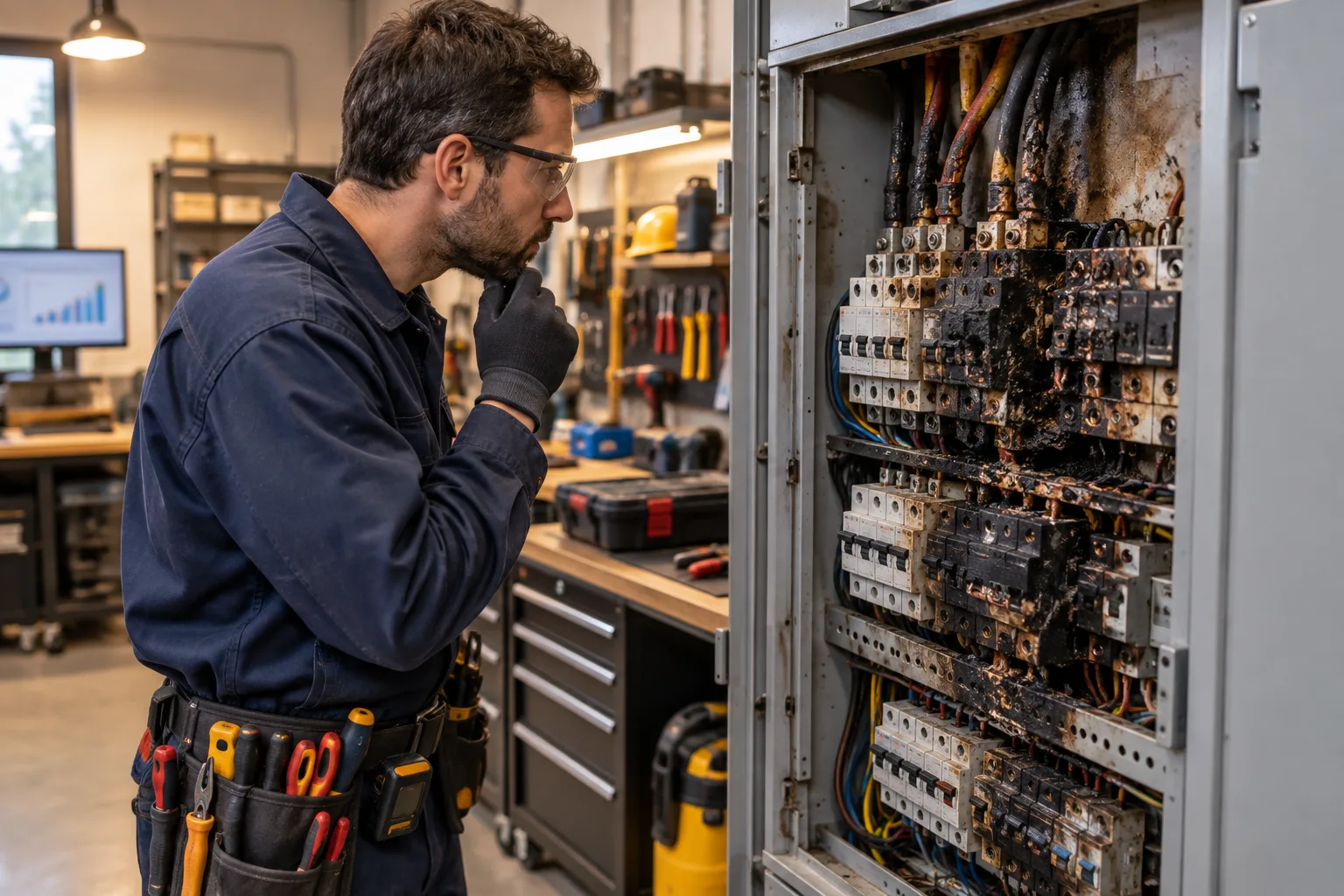
Accidental damage cover for business electronics

You paid the premium every month, assumed the commercial policy covered the equipment, and found out otherwise the Friday afternoon a laptop slid off the boardroom table onto polished concrete. The screen is dead, the machine holds three months of a tender submission nobody backed up properly, and the policy your broker sent at inception covers fire and theft. A drop onto a floor is neither. The gap between what you assumed was covered and what the wording says is, in most cases, a single clause.
What is accidental damage cover?
Accidental damage cover is an extension added to a business electronics or computer all risks policy that pays for sudden, unexpected physical damage caused by human error: a device dropped, liquid spilled onto a keyboard, a screen cracked by pressure in a bag. It isn't a default inclusion. Without it, your policy responds to fire, theft, and power surge, and leaves ordinary workplace accidents uninsured.
Key Takeaways
- Accidental damage cover is an optional extension, not a default feature, of most South African business electronics policies.
- It covers sudden, unforeseen physical damage caused by human error, such as drops, spills, and impact.
- The extension typically applies to portable devices: laptops, tablets, handheld scanners. It must be listed on the schedule to apply.
- Deliberate damage, wear and tear, and mechanical or software failure are standard exclusions regardless of how the extension is worded.
- The sum insured must reflect current replacement value, not purchase price, to avoid a proportional shortfall at claim time.
- A broker who reads the wording before the claim, rather than after, is the mechanism most likely to close the gap.
Why standard business electronics policies leave accidental damage out

Most business electronics policies, whether written as a standalone computer all risks section or as part of a broader commercial package, are designed around named perils: fire, lightning, theft, and power surge. The logic is that these perils are definable, their frequency is measurable, and an underwriter can price them. Accidental damage, by contrast, is a catch-all for whatever a person does wrong on any given day, and the frequency in an office of thirty people with portable devices is considerably harder to model.
The result is a policy structure where the named perils are included as standard, and accidental damage sits behind an additional premium. The Prudential Authority's non-life industry experience data shows the industry's catastrophe charges rising as the reinsurance market hardened, which partly explains why insurers are careful about what they bundle into base premiums. For a business with a fleet of portable devices, the extension is worth asking for by name at renewal. The wording won't volunteer it.
Ask for the extension wording in writing, so you can see exactly which events it covers and which it excludes.
What accidental damage cover typically includes
When the extension is in place, it generally responds to a narrow and specific category of loss: sudden, unforeseen, and fortuitous physical damage caused directly by an external event. In plain terms, something unexpected happened to the device from outside it.
Common inclusions across standard South African wordings are drops and impact (the device fell, was knocked over, or was struck by another object), liquid ingress from an accidental spill, pressure damage to a screen, and transit damage while the device is being carried between locations. For a logistics operator running handheld barcode scanners in a Johannesburg warehouse, or a Cape Town architecture practice where laptops travel between site visits and studio, these are daily exposures. The extension isn't a luxury for those businesses; it is the clause making the rest of the policy functionally useful.
One practical test: check whether the extension specifies "whilst in use" or "at any time". A policy covering the device only whilst in use in the office may leave a laptop bag in the boot of a car uninsured, even on the way to a client meeting. The difference lives in a single prepositional phrase and is worth confirming before the car journey, not after the bump.
What accidental damage cover usually excludes
The extension has a boundary, and that boundary carries real consequences as much as the inclusion does. Most wordings carve out several categories businesses commonly assume would be covered.
Wear and tear and gradual deterioration are excluded in almost every wording. A laptop screen degrading over time, a keyboard with failing contacts after three years of use, or a battery no longer holding charge are not accidents. They are the ordinary consequence of use, and they fall outside the scope of the extension. The insurer's position is that cover responds to an event, not to a condition.
Mechanical and electrical failure without an identifiable external cause is also a standard exclusion. If the device stops working and there is no dropped-device incident, no spill, and no observable external damage, most accidental damage clauses won't respond. The distinction between an accident and a malfunction can be blurry in practice: a device failing after a minor knock might generate a genuine dispute about which cause operated. The general principle is that the failure must trace to an identifiable physical event.
Deliberate damage is excluded everywhere, as is damage caused by a failure to maintain the equipment properly. Software corruption, virus damage, and data loss are also outside the scope of accidental damage cover specifically; those exposures belong to the electronic data processing insurance section, which is a separate extension addressing a different risk profile altogether.
How the sum insured works and why it changes your claim outcome

Accidental damage cover pays to repair or replace the damaged item up to the sum insured shown on the schedule. The mechanism sounds simple, but there is a gap catching businesses out with regularity.
Most businesses set their sum insured at purchase price and never revise it. A laptop bought for R22 000 three years ago may now cost R31 000 to replace with an equivalent model, because the rand has moved, component costs have risen, and the original spec has been discontinued. If the schedule still shows R22 000 and the replacement quote comes in at R31 000, the insurer pays to the limit of the schedule. The remaining R9 000 is yours to carry.
The further risk is the average clause, the rule applying a proportional reduction to your claim when your total sum insured for the class of equipment is lower than the total replacement value of the items on risk. Suppose your business carries ten laptops, each worth R31 000 to replace, but the schedule shows a total sum insured of R180 000 against a true replacement value of R310 000. The insurer treats the business as having carried 58 percent of the risk. A single R31 000 laptop claim pays out at roughly R18 000. The arithmetic isn't a penalty; it is a contractual consequence of setting the figures incorrectly at inception, and it applies whether the sum insured was understated intentionally or through inattention.
Reviewing the schedule annually, using current market replacement values rather than original purchase prices, is the adjustment costing little at renewal and making a material difference when a claim arises.
| Cover feature | Typically included | Typically excluded |
|---|---|---|
| Drop and impact damage | Yes | |
| Accidental liquid spill | Yes | |
| Screen pressure damage | Yes | |
| Transit damage (in transit) | Yes, if specified | Excluded if "in use only" wording applies |
| Wear and tear | Yes | |
| Mechanical or electrical failure | Yes (without external cause) | |
| Software or data loss | Yes (separate EDP section) | |
| Deliberate damage | Yes | |
| Damage by power surge | Yes (separate power surge section) |
Typical inclusions and exclusions under a South African accidental damage extension: confirm against your specific wording.
Portable versus fixed equipment: the distinction most policies draw
The accidental damage extension isn't uniformly available for all business electronics. Many wordings apply it only to portable or mobile equipment, defined as devices designed to be carried and used away from a fixed location. Laptops, tablets, handheld GPS units, and mobile point-of-sale terminals generally qualify. Desktop computers, fixed server equipment, and network hardware bolted to a rack in a server room typically don't, because the risk of dropping or spilling on a fixed machine is considerably lower and the named perils section is considered adequate for that exposure.
The distinction has a practical consequence for businesses running hybrid environments. A financial services firm in Sandton with twenty-four employees, all carrying laptops between home and office, has a materially different risk profile from a manufacturing plant with terminals fixed to production-floor stations. The first business needs the extension applied to every portable device on the schedule. The second may find it unnecessary on the fixed equipment and critical on the few tablets used by floor supervisors.
SASRIA cover, the state-backed layer responding to damage from riot, strike, civil unrest, and public disorder, sits separately from both the standard electronics policy and the accidental damage extension, as confirmed in SASRIA's motor and property cover documentation. If a device is damaged during a civil unrest event rather than through an ordinary workplace accident, the claim route is different and the policy responding is different. The two covers address distinct categories of loss and must both be in place for a business to be adequately protected across the full range of physical risks to its equipment.
Making a claim under an accidental damage extension
A claim under this extension is more documentary than most businesses expect. The insurer needs to confirm three things: that the device was listed on the schedule at the time of the loss, that the damage was caused by an identifiable accidental event rather than a pre-existing condition, and that the sum insured is sufficient to fund the repair or replacement.
The practical steps making a claim run more smoothly: photograph the damage immediately, before sending the device for assessment; keep the original invoice or a current market replacement quote; note the date, location, and circumstances of the incident; and report to your broker within the timeframe specified in the wording, which is usually 30 days but occasionally shorter. Delayed reporting is a common reason insurers reduce or reject electronics claims, not because they are looking for a reason, but because late reporting makes it genuinely harder to confirm the damage arose from the reported event rather than from subsequent handling.
Every claim works on the same principle: the claim file needs to tell a coherent story from incident to loss assessment to repair or replacement.
Loss adjusters on larger electronics claims, say a warehouse scanning system or a fleet of tablets across multiple sites, will typically ask for the full equipment schedule and may assess whether the sum insured reflects replacement values. Going into that conversation with an updated schedule, rather than discovering the underinsurance during the assessment, makes a measurable difference to the outcome.
The cost of no cover compared with the cost of the extension

The accidental damage extension isn't expensive relative to the risk it addresses. For a business running twenty laptops, each valued at R30 000, the total sum at risk from workplace accidents is R600 000. The extension premium for that exposure is typically a fraction of one percent of the sum insured per year, somewhere in the range of R3 000 to R6 000 annually depending on the industry, the insurer, and the claims history. These figures are illustrative only; actual premiums depend on the specific risk submitted for quotation.
The comparison worth making isn't premium versus premium. It is premium versus the cost of an uninsured replacement. A single uninsured laptop claim at R30 000 costs ten years of extension premiums at the lower end of that range. A spilled coffee on a tablet used by a site supervisor in a Durban construction firm is the kind of event happening once a quarter in a busy operation. The question at renewal isn't whether the extension is worth having. It is why it wasn't added at inception.
Add it at your next renewal.
Keeping your electronics cover in step with your business
Accidental damage cover for business electronics is one of the most straightforward extensions in the commercial policy toolkit, and it is also one of the most commonly omitted. The wording is short, the premium is modest, and the gap it fills, between the perils your base policy names and the ordinary human errors your employees make every day, is real and recurring. Reading the schedule now, before the next Friday afternoon drop, costs nothing and changes the outcome when something breaks.
You shouldn't have to discover what your electronics policy excludes the same afternoon a screen cracks. With Mont Blanc Financial Services you won't.
Contact Mont Blanc Financial Services to have your current computer insurance schedule reviewed, your accidental damage extension confirmed, and your sums insured updated before the next claim arrives without warning.
If you're wondering whether your existing computer insurance covers the specific devices your team carries, or how the extension interacts with power surge cover and electronic data processing insurance, the questions below address what South African business owners most commonly ask.
Frequently Asked Questions
Should I consider accidental damage insurance for my business electronics?
Yes, and the case is strongest if your business relies on portable devices: laptops, tablets, handheld scanners, or mobile terminals moving between locations, between employees, or between the office and client sites. The base section of a commercial electronics policy covers fire, theft, and power surge. It doesn't cover the dropped screen, the spilled coffee, or the tablet sliding off a workbench. For businesses where portable electronics are a core operational tool, an uninsured replacement isn't a minor inconvenience. It is an unplanned capital expense arriving at the worst time. The accidental damage cover extension typically adds a modest premium to the policy, and the sum insured should reflect current market replacement cost rather than the original purchase price. If your policy schedule doesn't show an accidental damage extension against your portable equipment, ask your broker to add it at the next renewal, or sooner, if the risk warrants it. Waiting until a device is damaged to find out the cover is absent is the most expensive way to learn this particular lesson.
What arrangements are available for accidental damage cover on business electronics?
Accidental damage cover for business electronics is most commonly arranged as an extension to a commercial electronic equipment or computer all risks policy, either as a standalone section or as part of a broader commercial package policy. The extension is listed on the schedule against the relevant items and applies only to equipment specifically named or described there. Some insurers offer blanket cover for portable equipment up to an agreed per-item limit, which suits businesses with a frequently changing device fleet. Others require each item to be individually listed with a serial number and sum insured. A third arrangement, less common in the commercial market, is a manufacturer or retailer protection plan purchased at point of sale. These are often warranty or service plans rather than commercial insurance, and their terms on repair, replacement, and exclusions can differ materially from a business electronics policy. For business use, a policy placed through a licensed insurer and broker, with the cover confirmed in the policy wording, is the arrangement offering the clearest claim pathway and the strongest consumer protection under South African law.
How do I apply for a claim under my accidental damage cover?
Notify your broker as soon as the damage occurs, within the timeframe specified in your policy wording: typically 30 days, though some wordings specify a shorter window. Document the incident immediately: photograph the damage from multiple angles before the device is moved or assessed, note the date, location, and exact circumstances, and preserve the original purchase invoice or obtain a current replacement quote from a reputable supplier. Your broker will submit a claim to the insurer and request a loss assessor where the value warrants it. The assessor's role is to confirm the damage is consistent with the reported incident, that the device was on the schedule at the time of loss, and that the sum insured is adequate to fund the repair or replacement. A clear, consistent account of the incident, supported by photographs and documentation, is the single factor most likely to move a straightforward claim through quickly. If there is a dispute about whether the damage arose from an accidental event or from a pre-existing condition, your broker's role is to represent your version of events and engage the insurer on the detail of the wording.
How do I return a damaged device under an accidental damage claim?
Once the claim is accepted, the insurer will typically direct you to an approved repairer or assessor. Don't send the device for repair independently before the claim is lodged, because doing so removes the insurer's ability to inspect the damage and confirm the cause, which is one of the grounds on which a claim can be declined. If the insurer instructs you to send the device to an approved repairer, follow their logistics instructions precisely and retain proof of dispatch. Where the device is assessed as beyond economic repair (a write-off rather than a repair), the insurer will settle on a replacement basis up to the sum insured on the schedule. Keep all correspondence, assessment reports, and repair invoices: they form part of the claim record and may be needed if the quantum is disputed. For items covered under computer insurance arrangements, the process mirrors the general short-term claims pathway, but the condition of the equipment schedule, including current values, correct serial numbers, and confirmed extension inclusions, determines the outcome more than any other single factor.
Nicola Iozzo
Founder & CEO, Mont Blanc Financial Services
Nicola has spent his career reading the policy wording most people skip, and writes here so you don't discover at claim stage what page 14 meant.
Everything on this blog is written to inform and educate. It is for information only. Nothing here is professional legal, financial, or technical advice. If you are making a significant business decision, speak to a qualified professional first. Mont Blanc Financial Services works hard to keep this content accurate and current, but is not liable for decisions made based on what you read here.
Mont Blanc Financial Services (PTY) Ltd. is an authorised financial services provider. FSP 8271