Insurance Average: How Underinsurance Cuts Your Claim Settlement
The fire was contained by the time the loss adjuster arrived. The building was insured, the premiums were paid, and the claim was valid. Then the settlement landed at sixty cents on the rand. The owner spent an afternoon working out how a fully paid policy had funded only part of a partial loss.
Nobody had hidden the clause. It had sat in the policy wording since inception, doing exactly what it was written to do. The owner had read the schedule once and filed it. The condition that governed the claim lived in the part of the document few people open until they need it.
What is insurance average?
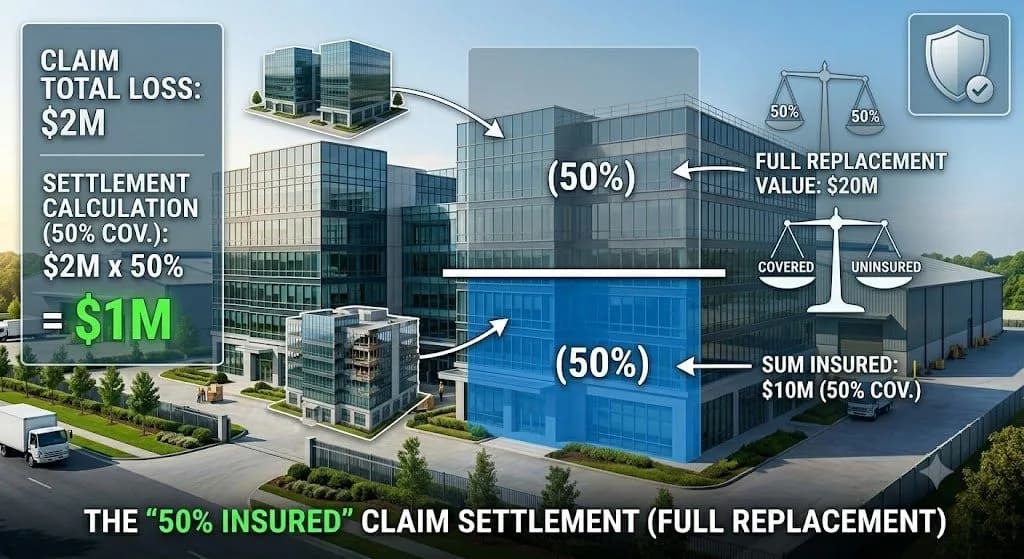
Insurance average is a policy condition that reduces a claim settlement in proportion to underinsurance. When the sum insured is lower than the full replacement value of the property, the insurer pays the same proportion of the loss, and the policyholder funds the shortfall. It applies to the material-damage sections of a commercial policy.
Key Takeaways
- Insurance average reduces a claim by the same proportion the property is underinsured, on partial and total losses alike.
- The calculation is fixed arithmetic: the sum insured divided by the value at risk, multiplied by the amount of the loss.
- Average sits in the fire, building, office contents and glass sections, not in the liability, motor or most all-risk sections.
- The benchmark for the sum insured is replacement cost, not market value or the original purchase price.
- A special condition of average can waive the reduction when the sum insured stays above a set percentage of the true value.
- Underinsurance is usually accidental drift from inflation, undeclared additions and ageing valuations, not a deliberate decision.
How underinsurance reaches the claim
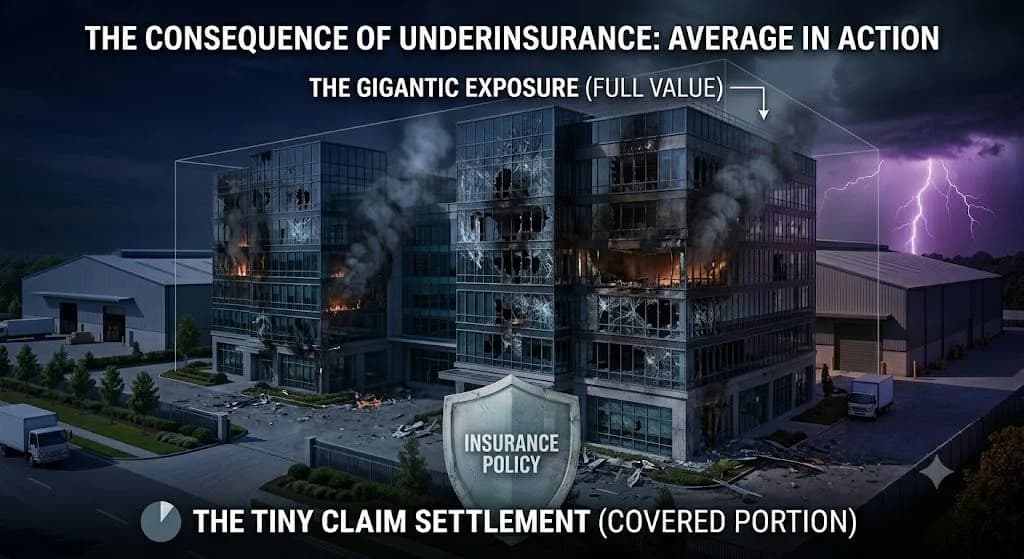
Underinsurance stays invisible until the claim, when the insurer applies the principle of average and the settlement comes back smaller than the loss your business suffered. Nothing flags it at renewal. The premium is paid, the cover looks intact, and the gap only becomes a number once it’s too late to change it.
Average exists to keep the premium pool fair. An insured who declares R6 million on a property worth R10 million has paid premium on roughly six-tenths of the risk the insurer carries. So a partial loss pays roughly six-tenths of the claim. The reduction isn’t punitive. It treats you as your own insurer for the share you never covered, and the insurer applies it as arithmetic, not discretion.
The sum insured you set at inception becomes the figure that limits the payout, whether or not anyone revisits it. On a building in a coastal town, the gap between a three-year-old figure and current rebuild cost can run into millions. The figure ages out of accuracy. Slowly, then all at once.
That timing is the difficulty. The number becomes an exact requirement at the moment it most needs to be exact, long after the estimate behind it was set. Average is the sharp edge of underinsurance, the condition that sits in your cover on every renewal that passes without a fresh valuation.
How insurance average is calculated
The calculation behind insurance average is one proportion, and it doesn’t bend. The insurer divides the sum insured by the value at risk, then multiplies by the amount of the loss. The result is what the policy pays.
Take a factory insured for R7 million when its replacement value is R10 million. A fire causes R4 million of damage. Average pays R7 million divided by R10 million, multiplied by R4 million, which comes to R2.8 million. The remaining R1.2 million is your own contribution, on a claim well inside the sum insured. The shortfall isn’t the difference between the loss and the cover. It’s a proportion of every rand claimed.
Worked example: how average reduces a partial-loss settlement
The settlement tracks the insured percentage, not the size of the loss. Disputes over this regularly reach the National Financial Ombud, the free body that resolves short-term insurance complaints in South Africa. Policyholders expect the cover figure to behave like a limit. It behaves like a ratio, and that difference is the money that doesn’t arrive.
Where insurance average applies, and where it doesn’t
Insurance average doesn’t sit in every section of your commercial policy. It lives in the material-damage sections, where the sum insured is meant to track replacement cost, not market value.
In practice, average is written into the fire, building, office contents and glass sections. An industry overview of how it applies confirms the same pattern across South African policies. It generally doesn’t attach to the liability, motor or most all-risk sections. Those respond to a defined limit or an agreed value, not to a declared replacement figure you keep current. The distinction shows up at claim, because the section that pays your fire loss is the section that can also reduce it.
Stock and contents complicate the picture. A retailer whose stock peaks before a festive season and falls afterward can be adequately insured in March. By November, on the same policy and the same sum insured, the figure is badly short. The figure was right once. Not any more.
So the valuation that needs your closest attention is the one attached to buildings, contents and stock. Not the liability limit, set as a round number at inception and rarely moved.
The special condition of average
A special condition of average can soften the standard clause, waiving the reduction when the sum insured stays above a set percentage of the true value. Many commercial policies carry one. Some don’t.
A standard clause applies the proportion at any level of underinsurance. A special or pro rata condition sets a threshold instead, often around 85 percent of value, and waives average above it. Insure for 90 percent of replacement value under such a condition and a partial claim pays in full. Insure for 80 percent and average returns, sometimes from the first rand. The exact threshold and wording vary by insurer and by policy version, so the condition in one schedule won’t read the same as the next. What counts is the percentage attached to it, not the label on the clause.
This is why the wording governs and the schedule only records. Insurers must disclose material policy terms under the Policyholder Protection Rules, though disclosure isn’t the same as comprehension. Worth saying plainly: a clause you were told about at inception still applies at claim, whether or not you registered what it meant. The question worth answering is whether your wording carries a special condition, and at what level it bites.
Why the sum insured drifts out of line
Most underinsurance isn’t a decision. It’s drift. The sum insured was accurate once, and then the world moved while the figure stayed where it was.
Three forces pull it below value. Building and material costs rise, so last year’s rebuild estimate understates this year’s. On a R12 million building, a two-year lag of even 8 percent a year leaves close to R2 million uninsured. Your business expands, adds plant, or carries more stock, and the schedule doesn’t catch up. And valuations age, so a figure set at the last formal assessment lags behind the number it was meant to track.
An escalation clause helps by lifting the sum insured each year. But a fixed percentage rarely keeps pace with sharp building inflation, and it does nothing for the extension nobody declared.
Business interruption cover drifts the same way, on a gross profit figure that can be years out of date by the time it’s tested. A claim then meets the same proportional cut, on the income the business was relying on to survive the interruption.
The fix isn’t complicated. It’s a yearly check of the sum insured against current replacement cost, done before the loss rather than discovered after it.
What average looks like at claim stage
At the claim, average is applied as arithmetic, not negotiated. The loss adjuster calculates the proportion from the sum insured and the assessed replacement value. The reduction follows from the numbers, not from anyone’s goodwill.
The loss adjuster is appointed by the insurer, not by you, and assesses the quantum of a valid claim on the insurer’s behalf. Part of that assessment is establishing the value at risk at the date of loss, the figure average is measured against. If that assessed value exceeds your sum insured, average applies, and it applies whether the claim is large or small. South African short-term insurance operates under the Short-term Insurance Act 53 of 1998, with insurers prudentially regulated under the Insurance Act 18 of 2017. Neither displaces the average clause, because it’s a term of the contract, not a creature of statute. How the loss is presented affects the assessed value, which is why documenting a claim carefully is part of managing the exposure.
None of this is negotiable once the loss has happened. The proportion is fixed by two numbers set long before the claim. The only point you can change the outcome is before there’s anything to claim for.
Where the settlement is decided

The settlement isn’t decided in the claim file. It’s decided years earlier, in the figure typed into the schedule and then left alone. Average doesn’t reward diligence or punish carelessness; it reads two numbers and returns a proportion. A business can survive the fire, the flood, the break-in, and still find the recovery funded only in part.
The cover was a percentage of the loss, and nobody meant it to be. The wording was never hidden. It was waiting for the figure to be wrong.
Average is one clause among many, and it makes more sense set against the rest of your personal insurance cover.
Average is not the only deduction; the excess and deductibles come off the same claim.
The root cause is usually the sum insured, which is the whole story of what being underinsured means.
You shouldn’t have to discover the average clause in the loss adjuster’s calculation. With Mont Blanc Financial Services you won’t.
Contact Mont Blanc Financial Services to check your sums insured against current replacement cost before a claim puts the figure to the test.
Once the arithmetic is clear, a few practical questions follow. They cover total losses, partial-loss calculations, and keeping a sum insured from drifting.
Frequently Asked Questions
What does insurance average cover in a commercial property policy?
Insurance average is a condition that reduces a claim in proportion to underinsurance. If the sum insured is 70 percent of the replacement value, the policy pays 70 percent of an otherwise valid claim, and the policyholder funds the rest. It applies to the material-damage sections of a commercial policy, including buildings, contents and stock, and operates as a calculation at claim stage rather than as a discretionary penalty. The condition exists so that policyholders who declare a full value, and pay premium on it, do not subsidise those who declare less. It is standard across South African insurers. The practical effect is that a property can be covered for a total loss in name, yet pay out only partially on any claim. The sum insured sets a ratio, not a simple ceiling. Keeping the sum insured aligned with current replacement cost is what stops average from reducing a settlement.
How is the average clause calculated on a partial loss?
The average clause uses one formula: the sum insured divided by the value at risk, multiplied by the amount of the loss. The result is the settlement. For example, a building worth R10 million and insured for R8 million faces a partial loss of R3 million. The calculation is R8 million divided by R10 million, multiplied by R3 million, which gives R2.4 million. The remaining R600 000 is the policyholder’s own contribution. The same proportion applies to any partial loss, regardless of size, so a 20 percent shortfall in the sum insured reduces every partial claim by roughly 20 percent. The value at risk used in the calculation is the replacement value at the date of loss, assessed by the loss adjuster, not the figure recorded when the policy began. This is why a sum insured that was accurate at inception can still trigger average years later, once rebuild costs have risen past the declared amount.
Does insurance average apply if a building is a total loss?
Insurance average applies to total losses as well as partial ones, though the effect looks different. On a partial loss, average reduces the settlement by the proportion of underinsurance. On a total loss, the settlement is capped at the sum insured in any event, so an underinsured property pays out the declared figure, already below the cost of rebuilding. Either way, underinsurance leaves a shortfall the policyholder funds. The distinction is that average is the mechanism on partial claims, while the sum insured acts as the ceiling on total claims. Both routes lead to the same place when the declared value is too low. A building insured for R6 million against a R10 million replacement cost recovers R6 million at most on a total loss, and a reduced proportion on anything less. Adequate cover, measured against replacement cost rather than market value, is the only thing that closes the gap.
How can a business avoid underinsurance and the average clause?
A business avoids the average clause by keeping each sum insured aligned with current replacement cost, not market value or book value. The most reliable method is a yearly review of declared values against the cost to rebuild or replace. That review adjusts for building inflation and for any new assets, extensions or stock added during the year. A professional valuation on larger properties gives a defensible figure and reduces the room for dispute at claim. An escalation clause helps between valuations by lifting the sum insured automatically, but it should be checked against actual cost increases rather than assumed to keep pace. Where a policy carries a special condition of average, staying above the stated threshold avoids the reduction entirely. The common thread is timing: underinsurance is corrected before a loss, never after one, because the average calculation at claim stage is fixed and not open to adjustment once the loss has occurred

Nicola Iozzo
Founder & CEO, Mont Blanc Financial Services
Nicola has spent his career reading the policy wording most people skip, and writes here so you don't discover at claim stage what page 14 meant.
This blog is here to inform, not advise. Think of it as a guidebook, not a contract. For decisions affecting your world, have a chat with your broker or financial professional.
Mont Blanc Financial Services (PTY) Ltd. is an authorised financial services provider. FSP 8271