Refrigerated cargo insurance: protecting temperature-sensitive loads

The reefer unit alarm goes off at 00:47 on the N3, somewhere between Harrismith and Mooi River, and the driver pulls over to find the refrigeration compressor has seized. The trailer holds R1.4 million in chicken portions bound for a Durban distribution centre. The truck is insured. The trailer is insured. But the load, and the precise reason the load is worth anything at all, is the cold. When that cold is gone, the value goes with it, and whether anyone pays for that loss depends entirely on whether the right policy was in place before the wheels left the depot.
What is refrigerated cargo insurance?
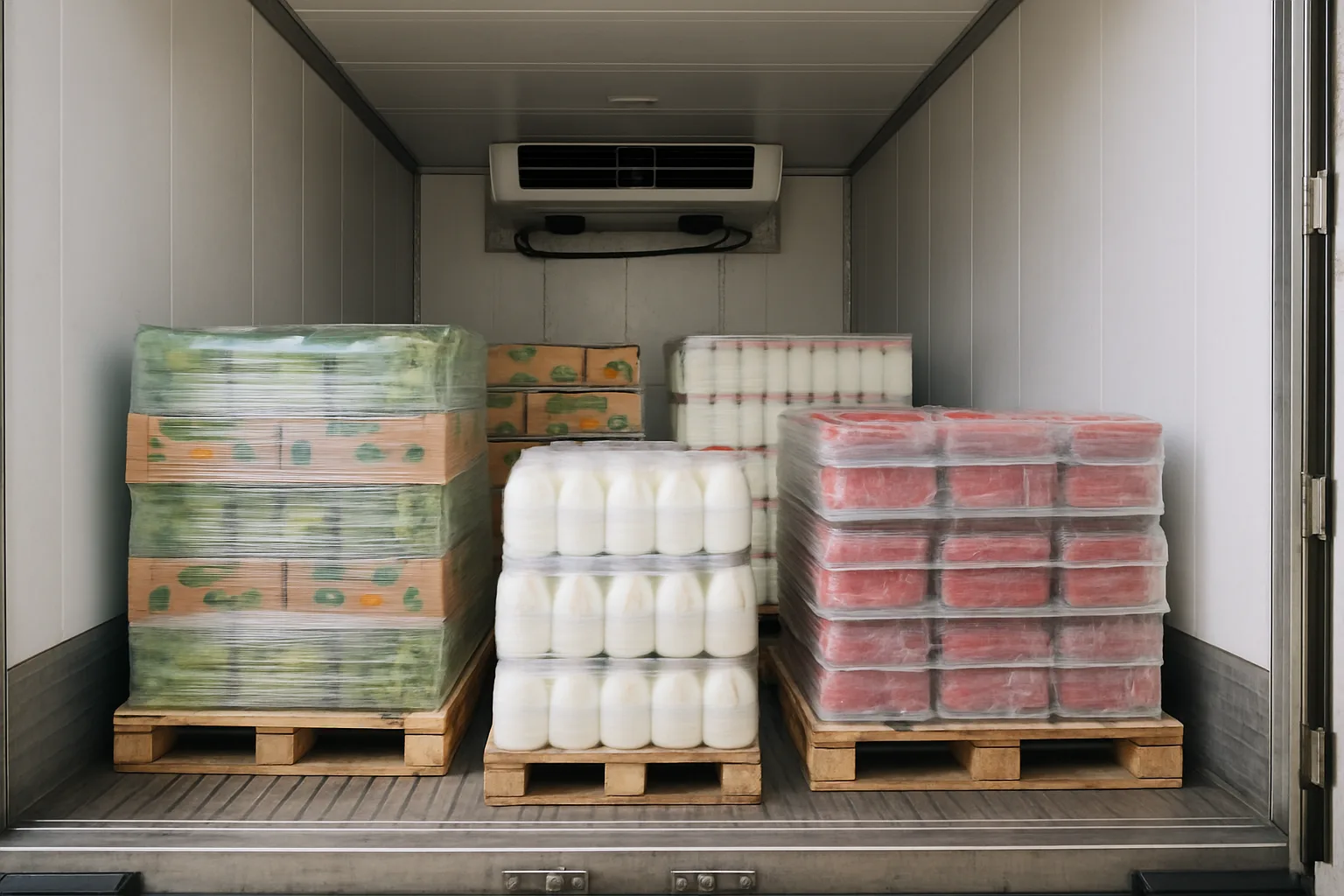
Refrigerated cargo insurance is a specialist form of goods in transit cover designed for temperature-sensitive loads: food products, pharmaceuticals, frozen goods, flowers, and any other cargo whose value depends on being kept within a defined temperature range. Beyond covering the physical load against theft, accident, and damage in transit, it specifically responds to spoilage losses caused by mechanical breakdown of refrigeration equipment, temperature excursions, and delays pushing the load past safe limits. Standard goods in transit policies, which cover most road freight for physical loss or damage, weren't built with temperature as a variable. Refrigerated cargo insurance was.
Key Takeaways
- A standard goods in transit policy covers physical loss and damage but doesn't automatically cover spoilage caused by a reefer unit failure. Cold-chain operators need specialist cover explicitly including temperature excursion.
- The two most common causes of cold-chain claims in South Africa are mechanical breakdown of refrigeration equipment and delays at border posts or weighbridges pushing transit times beyond safe limits.
- Pharmaceutical loads and certain perishable food categories carry stricter temperature tolerances and typically require separate endorsements or dedicated pharmaceutical cargo policies.
- Underinsurance is a significant risk for cold-chain operators: the sum insured must reflect the full replacement cost of the cargo at destination, including the premium paid for cold-chain logistics, not merely the purchase price at origin.
- Pre-departure temperature records, continuous in-transit temperature logs, and load acceptance documentation are the three pieces of evidence deciding most refrigerated cargo claims.
Why a standard GIT policy leaves cold-chain operators exposed
Goods in transit insurance, known in the industry as GIT cover, is the policy most road freight operators carry. It covers the cargo against physical loss or damage during transit: theft, an accident, fire, or the load shifting and breaking during the journey. The critical limitation for cold-chain work is that GIT was designed around the idea that cargo either arrives or it doesn't. A pallet of steel flanges is either stolen or it isn't. The temperature those flanges experienced on the way is irrelevant.
Perishable and temperature-sensitive cargo introduces a third outcome: the load arrives physically intact but commercially worthless. A trailer of fresh salmon spending six hours at eight degrees Celsius instead of two degrees is still physically present on the truck, with no sign of theft or accident. Under a standard GIT policy, such a claim has no anchor. The cargo wasn't stolen and it wasn't damaged in the conventional sense. The policy schedule says nothing about temperature, and the exclusions say nothing because they don't need to: the cover never included temperature risk in the first place.
The SAIA Code of Practice for Goods in Transit insurance makes this boundary reasonably clear, and the larger underwriters in the cold-chain space write GIT extensions or standalone perishable cargo policies to fill it. The gap exists in the market because it has to be filled deliberately, and it closes only when someone asks for it at inception.
The specific perils a refrigerated cargo policy should cover
A purpose-built refrigerated cargo insurance policy addresses the failure modes standard GIT ignores. The first is mechanical breakdown of the refrigeration unit. A reefer trailer's cooling system is a diesel-powered compressor attached to the front of the trailer, and it can fail from a seized compressor, an electrical fault, a fuel starvation problem, or a blocked condenser. Any of these can send the trailer's internal temperature climbing within an hour. The policy should respond to spoilage losses caused by that failure without requiring the insured to also claim under the truck's mechanical breakdown cover.
The second peril is temperature excursion caused by delay. A pharmaceutical load sitting at a weighbridge for four hours in the Limpopo summer is experiencing a temperature event even if the reefer is running, because the unit may not have the capacity to hold temperature against ambient heat when the trailer doors are opened for inspection. Delays at border posts are a particular exposure for cross-border cold-chain operators moving loads between South Africa, Zimbabwe, and Mozambique.
The third peril is power failure at a depot or cold store where the load is temporarily held. If the cargo is in a cold room at a transshipment point and the facility loses power, the question of which policy responds, the operator's property cover or the cargo policy, needs to be settled before the load spoils, not during the claim. Your broker should confirm in writing which policy responds in that scenario before a load reaches a transshipment point.
Comparison of cover: standard GIT vs refrigerated cargo insurance
| Peril | Standard GIT | Refrigerated cargo insurance |
|---|---|---|
| Theft of cargo | Covered | Covered |
| Accident damage | Covered | Covered |
| Reefer unit mechanical breakdown | Not covered | Covered (specialist) |
| Temperature excursion from delay | Not covered | Covered (with endorsement) |
| Spoilage at transshipment cold store | Not covered | Covered (with endorsement) |
| Pharmaceutical temperature deviation | Not covered | Covered (dedicated policy) |
Documentation: what decides the claim
Temperature records are to a refrigerated cargo claim what dashcam footage is to a trucking accident claim. Without them, the assessment becomes a dispute about what probably happened, and disputes about what probably happened tend to resolve in the insurer's favour.
Most modern reefer units carry a built-in temperature recorder logging the trailer's internal temperature at set intervals, typically every five or fifteen minutes, and storing the data for download. A clean temperature log showing the unit maintained the correct range for the entire journey is the first piece of evidence a loss assessor asks for. If the log shows a deviation, the assessor wants to know when it started, how long it lasted, and what peak temperature was reached. Those three figures, combined with the cargo type and its time-temperature tolerance profile, determine whether the load is a total loss, a partial loss, or still within safe limits.
The second document is load acceptance evidence at origin: the sign-off confirming the cargo was loaded at the correct temperature. Spoilage claims are frequently disputed on the grounds the cargo was already outside temperature when loaded, meaning the cold-chain failure happened before the transporter took custody. A signed load acceptance record with a temperature reading at the time of loading removes that argument.
The third is the trip sheet and any weighbridge or delay records, because they establish the timeline. An assessor reconstructing a cross-border delay claim needs to know exactly how many hours the load spent at each point on the route.
Pharmaceutical loads and the stricter tolerance problem
Pharmaceutical cargo, including vaccines, blood products, insulin, and temperature-sensitive oncology treatments, operates in a narrower temperature band than food. Most pharmaceutical cold-chain protocols require continuous maintenance between two and eight degrees Celsius, and any deviation outside that range requires a formal deviation report and, in many cases, a quarantine decision from the manufacturer's quality team before the product can be used.
From an insurance perspective, this creates a claims dynamic stricter and slower than a food spoilage claim. A food spoilage claim resolves when the assessor confirms the temperature excursion and agrees the load is unsaleable. A pharmaceutical claim may involve the manufacturer's quality control team, a regulatory notification under the South African Health Products Regulatory Authority's guidelines, and a destruction order before the loss quantum is even confirmed.
Policies covering pharmaceutical cargo need to reflect this. The sum insured must account for the full replacement value of the product at the point of loss, not the manufacturer's cost. The indemnity basis, which is the method the insurer uses to calculate the payout, should be agreed value rather than market value, because pharmaceutical products don't have a spot market price in the way fresh produce does. The policy should also include cover for the costs of compliant destruction, which can be substantial for controlled substances.
Underinsurance and the sum insured trap

Cold-chain operators are as vulnerable to underinsurance as any other cargo class, and the calculation is slightly more complex than for dry goods. The sum insured for a refrigerated load should reflect the full replacement value of the cargo at destination, not the purchase price at origin.
Consider a consignment of frozen prawns purchased in Mozambique for R800,000, transported to Johannesburg on a vehicle costing R60,000 in cold-chain logistics, with a landed selling price of R980,000. If the insured declares R800,000 as the sum insured and the load is a total loss, the insurer applies average: the policy covered 82 percent of the actual value, so the claim pays out at 82 percent. The R176,000 shortfall is the operator's problem, not a rounding error, and it arrives in the same week as the cost of sourcing a replacement load to keep the customer.
The average clause works like this: if you insure a load for less than its full value, the insurer treats you as having carried a share of the risk yourself, and any claim pays in proportion to how much of the risk you insured. Getting the declaration right at inception, and updating it when commodity prices shift, is the unglamorous part of cold-chain risk management preventing the worst arithmetic from landing on your desk.
SASRIA and political risk on refrigerated loads
South African Special Risks Insurance Association cover, better known as SASRIA, is the state-owned insurer handling damage caused by riot, strike, civil unrest, and public disorder. It is a separate policy riding alongside the main cargo policy, collected by the insurer as a small additional premium and passed to SASRIA. The transport sector learned during the July 2021 unrest in KwaZulu-Natal exactly how quickly a stationary refrigerated load can become a spoilage claim: trucks were stopped on the N3, loads were looted, and trailers sat immobilised for days in the heat.
A SASRIA endorsement on a refrigerated cargo policy responds to physical loss and damage caused by unrest, but the temperature-excursion losses following from a delay caused by unrest are a separate question. The main cargo policy may cover spoilage from delay if the delay clause is broad enough; it may not if the trigger requires a mechanical cause. This kind of gap exists in writing but surfaces at claim time, and it is worth clarifying with your broker before a load moves through a high-risk corridor.
SASRIA publishes its current cover limits and risk classes for cargo and other movable property, and those limits apply per vehicle per event. For a single refrigerated trailer carrying a high-value pharmaceutical or food load, the SASRIA limit may not be sufficient on its own, which makes the interaction between the SASRIA schedule and the main cargo policy worth reviewing.
Choosing a broker and policy for cold-chain operations
Refrigerated cargo insurance is a specialist product, and the quality of your cover depends heavily on the quality of the questions asked before the policy is placed. A broker handling general commercial lines competently may not be familiar with the specific wording differences between a GIT extension for perishables and a standalone cold-chain cargo policy, or with the pharmaceutical cargo underwriters carrying the right appetite for biological products.
The right broker asks about the commodity types you carry, the temperature ranges required, the typical transit routes and their delay exposure, the reefer equipment specification, and the documentation systems in place. The Road Freight Association's guidelines on cold-chain operations in South Africa provide a practical framework for what a well-run cold-chain operation looks like from a risk management perspective, and a broker referencing that kind of operational context is working from the right base. The FSCA's register of licensed financial services providers is the practical starting point for confirming any broker placing this cover holds the appropriate licence and product category authorisation.
The policy wording, specifically the spoilage clause, the delay trigger, and the temperature excursion definition, should be read and explained before a single load moves under it. A verbal assurance the cover is comprehensive isn't cover. The wording is.
Cold-chain cover sits on top of the ordinary vehicle and cargo sections, not instead of them. Our guide to trucking insurance sets out that base layer.
When the compressor seizes and the policy answer counts most

Most cold-chain operators discover what their policy does and doesn't cover at the moment least convenient for their cash flow and most consequential for the customer waiting on the load. The compressor seizes, the prawns warm up, and the question of whether the right cover was in place becomes very specific, very fast. The answer was settled months earlier, in a conversation that either happened or didn't.
You shouldn't have to find that answer at midnight on the N3. With Mont Blanc Financial Services you won't.
Contact Mont Blanc Financial Services to have your current refrigerated cargo cover reviewed against the loads you actually carry, the routes you actually run, and the documentation systems you actually have in place.
The questions below come up regularly from cold-chain operators reviewing their cover for the first time, or after a claim paying out less than expected.
Frequently Asked Questions
Does my standard goods in transit policy cover refrigerated cargo?
Standard goods in transit insurance covers physical loss and damage to cargo, which includes theft, accident, fire, and impact damage. It doesn't automatically cover spoilage losses caused by temperature excursion, mechanical breakdown of refrigeration equipment, or delays pushing a load outside its safe temperature range. Those losses require a specific cold-chain endorsement or a standalone refrigerated cargo policy. If your current GIT policy schedule doesn't name temperature excursion or spoilage as a covered peril, treat it as excluded. The practical test is to read the spoilage clause, or confirm with your broker in writing the policy responds to a reefer unit breakdown. A verbal assurance isn't sufficient. The SAIA Code of Practice for GIT insurance sets out the baseline structure for GIT policies in South Africa and helps clarify where standard cover ends. Reviewing that document alongside your own policy schedule will show you exactly where the gap sits and what endorsement language is needed to close it.
What documentation do I need to submit a refrigerated cargo insurance claim?
A refrigerated cargo claim typically requires four core documents: the reefer unit temperature log for the full duration of the trip, a signed load acceptance record showing the cargo's temperature at the time of loading, the trip sheet with timestamps for departure, stops, delays, and delivery, and the delivery note or rejection documentation from the consignee. If the claim involves a reefer unit breakdown, the driver's report of the fault and the technician's inspection report are also required. Pharmaceutical cargo claims additionally require a deviation report and a quarantine or destruction order from the manufacturer's quality team. Carriers without continuous temperature logging in place are significantly more exposed at claim time, because the temperature record is the primary evidence the loss assessor uses to determine whether a temperature excursion occurred and when it started. If your fleet runs older reefer units without digital loggers, fitting them before the next load is a practical risk management step that strengthens your position on any future claim.
How is the sum insured calculated for a refrigerated load?
The sum insured for a refrigerated cargo load should reflect the full replacement value of the cargo at destination, not the purchase price at the point of origin. For a food product purchased in another province or country and transported to a distribution centre, the destination value includes the purchase price, the cold-chain logistics cost, import duties where applicable, and any other costs the operator has incurred to bring the load to the point of sale. Insuring only the purchase price at origin leaves you underinsured, and the average clause will reduce any claim payout proportionally to the shortfall. Commodity prices for fresh and frozen produce fluctuate, so the declared sum insured should be reviewed at renewal and updated when the commodity price or logistics cost changes significantly. Pharmaceutical products should be insured on an agreed value basis, with the sum insured confirmed by the manufacturer or distributor. Reviewing your declared values annually, rather than rolling over last year's figure, is the most reliable way to keep the average clause from reducing a legitimate claim.
Does refrigerated cargo insurance cover cross-border loads into Zimbabwe or Mozambique?
Cover for cross-border refrigerated loads depends on the territorial limits specified in your policy. Most South African cargo policies can be extended to cover transit into sub-Saharan Africa, including Zimbabwe and Mozambique, but the extension needs to be specifically requested and confirmed in the policy schedule before the load departs. Cross-border routes carry specific delay exposures at border posts, which are the most common trigger for temperature excursion on longer runs. Some underwriters impose sub-limits on cross-border loads, particularly for pharmaceutical cargo, or require additional documentation such as phytosanitary certificates or health certificates for food products. SASRIA cover doesn't automatically extend beyond South African borders, so political risk on cross-border loads requires a separate endorsement or a political risk policy. Confirm the territorial limits, the delay clause, and the SASRIA position with your broker before the first cross-border load moves.

Nicola Iozzo
Founder & CEO, Mont Blanc Financial Services
Nicola has spent his career reading the policy wording most people skip, and writes here so you don't discover at claim stage what page 14 meant.
Everything on this blog is written to inform and educate. It is for information only. Nothing here is professional legal, financial, or technical advice. If you are making a significant business decision, speak to a qualified professional first. Mont Blanc Financial Services works hard to keep this content accurate and current, but is not liable for decisions made based on what you read here.
Mont Blanc Financial Services (PTY) Ltd. is an authorised financial services provider. FSP 8271