Underinsurance in Farming: The Audit No One Expects

A farm insurance schedule has a quiet way of describing a farm that no longer exists: a barn at its 1998 value, a tractor valued a decade ago, a bakkie never added at all. Costs rise and equipment ages while the premium continues as if time stood still. None of it feels like a problem until a claim arrives and the average clause applies. The gap between insured value and replacement cost is where the loss compounds.
What is farm underinsurance in South Africa?
Farm underinsurance in South Africa is the gap that opens when a farm’s insured values fall below the actual cost of replacing its assets. It develops gradually as building, machinery, and livestock costs rise while sums insured stay static. At claim stage, the average clause reduces the settlement in proportion to the shortfall, leaving the difference as the farmer’s responsibility.
Key Takeaways
- Farm underinsurance is the gap between what a farm is insured for and what its assets would actually cost to replace today.
- It develops quietly through farming itself, as costs rise and valuations age while paperwork is deferred, rather than through carelessness.
- Rising construction, machinery, and transport costs widen the gap each year, so a barn insured at R800,000 might now cost far more to rebuild.
- The average clause reduces a claim in proportion to the shortfall, so a farm insured at half its value receives roughly half the loss.
- Regular revaluation against current replacement costs, not the original purchase price, is the defence against underinsurance.
Why Underinsurance Is More Common Than Crop Failures

Underinsurance is not caused by carelessness. It is caused by farming.When you manage fields, livestock, machinery, weather, labour, diesel, water, and a calendar which refuses to co-operate, paperwork falls somewhere between “later” and “not today.”
The South African Insurance Association (SAIA) notes a steep rise in underinsurance cases across rural sectors due to rising replacement costs and outdated valuations. Stats SA confirms ongoing inflation in construction materials, machinery imports, and transport.
Every year, the gap between what you insure and what you need grows.
You might insure a barn for R800 000, but rebuilding it today costs R1.6 million. You might insure a tractor at R200 000 when the cheapest replacement costs R450 000. The difference becomes your responsibility during a claim.
Underinsurance is not a small gap. It is a hole deep enough to swallow an entire harvest.
The Average Clause: The Villain No One Sees Coming
Here is where the real plot twist enters:If you insure something for less than its true value, insurers apply the average clause, a calculation which makes grown adults reconsider their life choices.
Here is a simple example, told without painkillers:
- Your barn is worth R1 000 000.
- You insure it for R500 000.
- A fire causes R200 000 damage.
You do not get R200 000.You get 50 percent of the loss, because you insured 50 percent of the value.Your payout becomes:
R500 000 ÷ R1 000 000 = 50 percent50 percent of R200 000 = R100 000
The insurer pays R100 000.You cover the remaining R100 000.
The Ombudsman for Short-Term Insurance (OSTI) confirms which average clause disputes make up a large proportion of rejected or reduced agricultural claims every year.
Farmers often say, “but I never claimed before” or “I thought the value was fine.” Insurance does not reward good behaviour; it rewards correct valuations.
Underinsurance is a financial boomerang. Eventually it comes back, and it never misses.
How to Spot Underinsurance Before You Learn the Hard Way
A farm insurance audit works like an agro version of a health check. It tells you what looks good, what needs review, and what could destroy you faster than a cold snap in lambing season.
Here is what MBFS checks during a farm audit:
1. Asset Register Accuracy
Most farms list machinery once and never update it again. If you bought, sold, repaired, repurposed, or rehomed anything, your policy must follow.
2. Current Replacement Values
We look at today’s prices, not yesterday’s optimism.Stats SA machinery and building inflation rates tell us everything we need.
3. Building and Structural Updates
A renovated barn is not the same structure you insured ten years ago.New roofing, additional storage, solar panels, packhouse extensions, all change the rebuild cost.
4. Livestock Valuation Accuracy
Livestock prices shift frequently.DALRRD livestock market reports reflect updated values which should match your cover.
5. Policy Gaps No One Notices
Cold rooms, irrigation systems, solar installations, feed silos, borehole pumps, and generators often fall into the “I thought it was included” category.
We fix this before you end up learning through a claim.
Getting the sums right is the whole of the exercise. The parent guide to agricultural insurance walks through each section a farm policy should carry.
Why Emerging Farmers Are Most at Risk
Emerging farmers often inherit underinsurance unknowingly.Policies may come from grant programmes, co-operatives, or inherited operations, and they frequently lack updated valuations.
The Land Bank Development Report highlights which early-stage farmers face greater financial risk because they operate with limited reserves. A single underinsured event can be business-ending
Shared risk models work well, but only when the underlying insurance is accurate. Our brokers run audits for co-ops and clusters to ensure each member is protected at the right level.
Underinsurance hits emerging farmers hardest, and recovery without support is nearly impossible.
Why MBFS Audits Cost Nothing but Save Everything
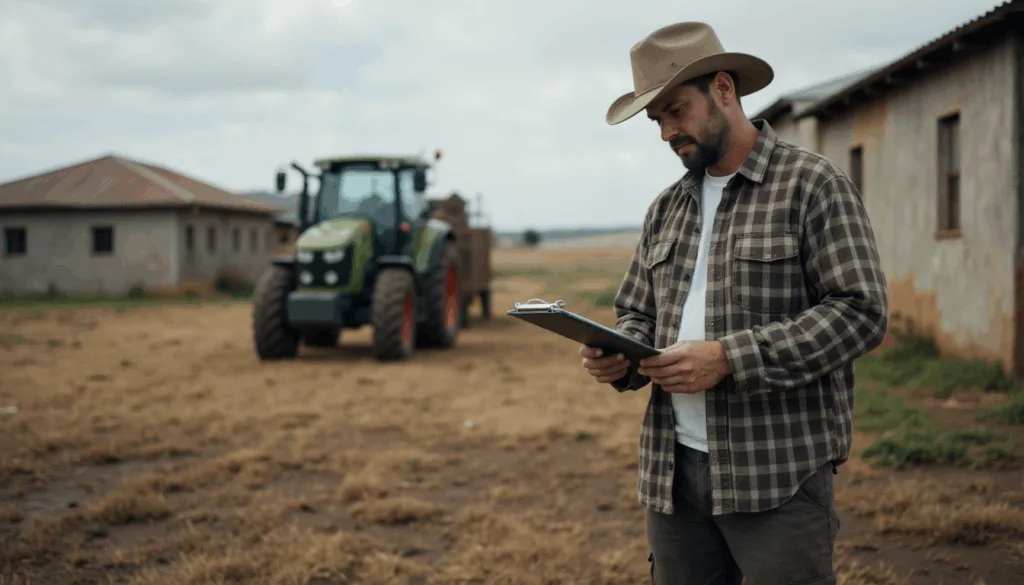
An MBFS farm insurance audit is simple:We ask the right questions, examine the right numbers, and compare everything with real market values.
We then adjust your policy so claims pay out correctly without average clause penalties.You walk away with:
- Updated replacement values
- Correct asset listings
- Realistic livestock valuations
- Clarity on what falls under which section
- Better premium efficiency
- Peace of mind
Insurance is only useful when it works.Underinsurance makes sure it does not.
Frequently Asked Questions
What is farm underinsurance in South Africa?
Farm underinsurance in South Africa is the situation where a farm’s insured values have fallen below what it would actually cost to replace its assets, leaving a gap the farmer carries. It develops gradually rather than through any single mistake: as the years pass, building costs rise, machinery becomes more expensive to replace, and livestock values shift, while the sums insured on the policy often stay where they were set. A barn insured at its value years ago, a tractor at a decade-old figure, or an asset never added to the schedule at all all contribute to the gap. The result is a policy that describes a farm as it once was rather than as it is. The shortfall stays invisible while no claim is made, which is why it so often goes unnoticed. It becomes concrete only when a loss occurs and the settlement falls short, at which point the difference between the insured value and the replacement cost becomes the farmer’s responsibility.
How does the average clause affect farm underinsurance claims?
The average clause is the mechanism that turns farm underinsurance into a reduced payout, applying proportional settlement when assets are insured below their replacement value. In practical terms, if a farm insures something for less than it is worth to replace, the insurer pays the same proportion of any claim. A barn insured for half its true replacement cost would yield roughly half the claim, with the farmer carrying the rest, and this applies to partial losses as well as total ones, which is what most surprises people. The logic is that the farmer paid premiums on a lower value, so the insurer indemnifies only that proportion. For a farm, where assets are large and replacement costs have risen sharply, the shortfall can be substantial, deep enough to undo a season’s recovery. The average clause is not a penalty but a calculation, and it bites precisely when a farmer can least afford it. Avoiding it depends on keeping insured values aligned with current replacement costs rather than letting them drift.
Why is farm underinsurance so common in South Africa?
Farm underinsurance is common in South Africa because it arises from the nature of farming itself rather than from negligence. A farmer managing fields, livestock, machinery, weather, labour, diesel, water, and an unforgiving calendar has limited time for paperwork, and updating insurance valuations tends to fall between later and not today. Meanwhile, the costs that determine replacement values keep rising: construction materials, imported machinery, and transport all inflate over time, so the gap between insured and actual values widens every year even when nothing on the farm changes. Industry observers have noted a steep rise in rural underinsurance, driven by exactly these rising replacement costs and outdated valuations. The combination of deferred paperwork and steady cost inflation means underinsurance creeps in almost automatically unless actively prevented. This is why it is described as something that happens quietly while the farmer focuses on everything else. Recognising it as a structural tendency of farming, rather than a personal failing, is what prompts the regular revaluation needed to keep cover aligned with reality.
How can farmers avoid underinsurance in South Africa?
Farmers avoid underinsurance by regularly revaluing their assets against current replacement costs rather than carrying forward old figures. The core discipline is to reassess buildings, machinery, livestock, and vehicles periodically, ideally at least once a year, and to update the sums insured to reflect what each would actually cost to replace today, not what it cost when bought. This matters most for assets whose replacement cost has risen sharply, such as buildings, where construction inflation can leave an old valuation far short. Ensuring every asset is actually listed is part of this, since an item left off the schedule, a bakkie, a piece of equipment, is simply uninsured. Adjusting for inflation on an ongoing basis keeps the cover matched to reality as costs climb. The practical step is to treat valuation as routine farm housekeeping rather than a once-off task, so the policy keeps pace with the farm. Where the values are kept current, the average clause has nothing to bite on, and a claim is settled on the footing the farmer expects.
Closing Reflection
Underinsurance is not a dramatic event. It is a quiet, slow leak which empties your wallet only when you need it most.A proper audit turns confusion into clarity and disaster into recovery.
You shouldn’t have to discover your barn was insured at its 1998 value when it burns down today. With Mont Blanc Financial Services you won’t.
Contact Mont Blanc Financial Services to revalue your farm’s assets against current replacement costs before the average clause does it for you.

Nicola Iozzo
Founder & CEO, Mont Blanc Financial Services
Nicola has spent his career reading the policy wording most people skip, and writes here so you don't discover at claim stage what page 14 meant.
This blog is here to inform, not advise. Think of it as a guidebook, not a contract. For decisions affecting your world, have a chat with your broker or financial professional.
Mont Blanc Financial Services (PTY) Ltd. is an authorised financial services provider. FSP 8271