The MBFS Farmer’s Guide to Agricultural Insurance
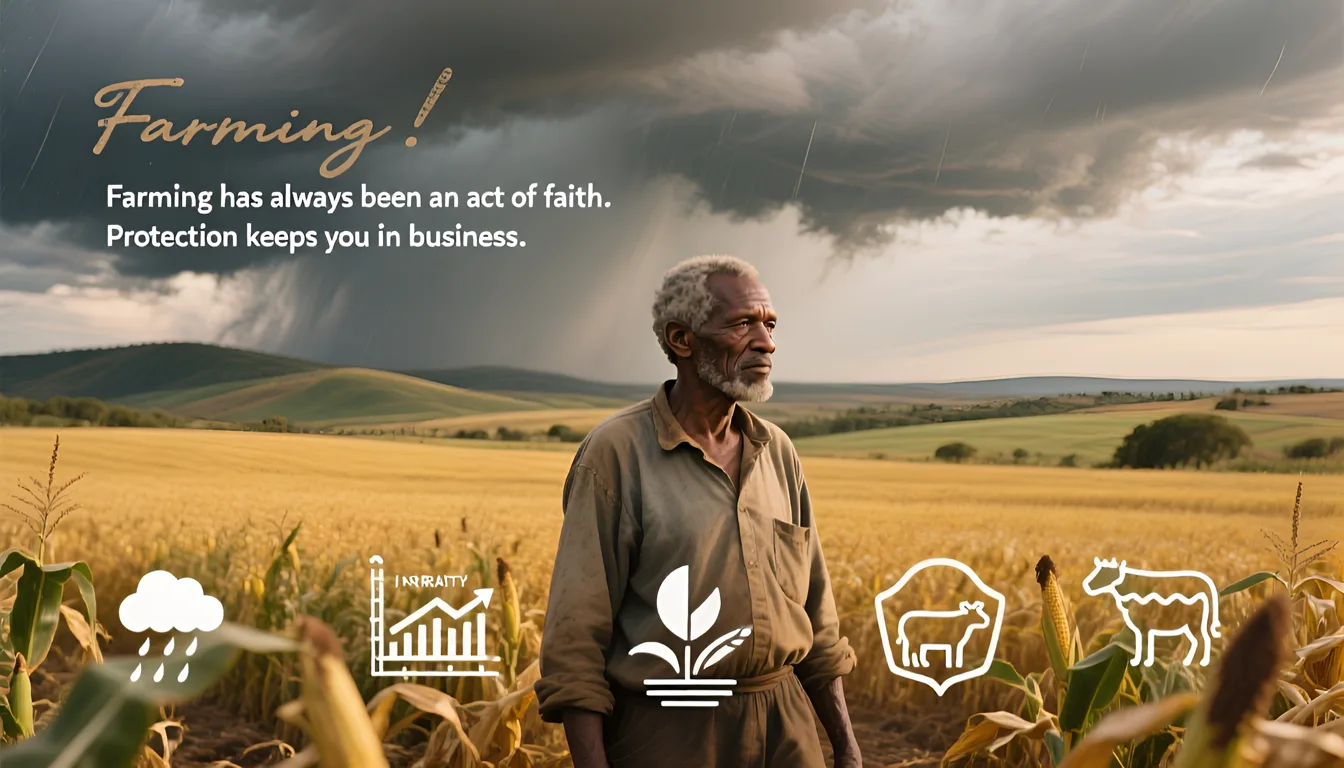
Farming runs on forces no operator controls: the weather, the market, the disease that moves through a herd overnight. Agricultural insurance exists to keep the business standing when one of them turns, preserving the work rather than the courage behind it. Yet most farm cover is bought as a single product and assumed to fit, when the sector’s risks demand cover built around seasons and a specific operation. That mismatch is where farm claims fail.
What is agricultural insurance?
Agricultural insurance is financial protection designed for farmers and agribusinesses, covering the forces that threaten farm income and assets: climate, pests, disease, accidents, and market disruption. Unlike ordinary business cover built around quarters, it is structured around the farming cycle of planting, growth, harvest, and storage. It spans crop, livestock, equipment, business interruption, and liability cover.
Key Takeaways
- Agricultural insurance protects farm income and assets against climate, pests, disease, accidents, and market disruption, structured around the season rather than the quarter.
- It rests on several pillars: crop cover for weather losses, livestock cover for theft and disease, and asset cover for machinery and equipment.
- Business interruption cover replaces lost income when an event halts operations, and liability and transport cover address third-party and goods-in-transit risk.
- Cover is built around the specific operation, since a maize farm, a macadamia orchard, and a dairy each carry different exposures.
- The aim is not only to pay out when things go wrong but to keep the farm operating long enough to recover.
1. What Is Agricultural Insurance?
Agricultural insurance is financial protection designed specifically for farmers and agribusinesses. It covers the unpredictable forces, climate, pests, disease, accidents, and market disruption, which threaten income and assets.
Unlike ordinary business insurance, agricultural cover is built for seasons, not quarters. It understands the rhythm of planting, growth, harvest, and storage. The goal isn’t only to pay out when things go wrong; it’s to keep the business moving long enough to recover.
There are five main pillars of agricultural insurance:
- Crop Insurance – Protects against weather-related losses such as drought, flood, hail, frost, or fire.
- Livestock Insurance – Covers theft, disease, and accidental death of animals.
- Asset and Equipment Insurance – Safeguards machinery, vehicles, irrigation systems, and storage facilities.
- Business Interruption Cover – Replaces lost income when an event stops operations.
- Liability and Transport Insurance – Protects against third-party damage and goods-in-transit losses.
Each of these pillars plays a part in making farming sustainable, no matter what the season decides to do next.
2. Why Farmers Need Insurance
Farming in South Africa is a balancing act between nature and economics. Weather patterns are shifting, fuel costs climb unpredictably, and markets fluctuate with international demand. According to Agri SA, extreme weather events have doubled over the last decade, costing the sector billions annually.
For large-scale commercial operations, one season’s losses can erase years of investment. For small and emerging farmers, it can mean starting over entirely. Insurance turns these risks into managed variables instead of fatal surprises.
Here’s why it’s essential:
- Stability: Replaces income after a bad harvest, helping with cash flow.
- Security: Protects assets used as loan collateral.
- Credibility: Lenders and buyers prefer insured farmers.
- Continuity: Keeps workers employed and production moving.
In short, insurance transforms unpredictability into resilience. It’s not a safety net for failure, it’s a foundation for survival.
3. Types of Agricultural Insurance
Crop Insurance
Crops are vulnerable to almost everything, too much rain, too little, frost in spring, or hail on harvest day. Crop insurance compensates for yield loss or quality reduction caused by natural events.
Many South African insurers now use satellite data and weather indexing to verify damage quickly. This technology speeds up payouts and removes disputes over rainfall records. Whether you grow citrus, maize, or grapes, policies can be tailored to your region and risk level.
Livestock Insurance
Animals are both assets and livelihoods. Livestock cover protects against theft, accidents, and diseases such as foot-and-mouth or lumpy skin. It can include transit protection for animals moved to auctions or feedlots. Some policies even cover veterinary care and mortality during drought or heat stress.
Asset and Equipment Insurance
Tractors, harvesters, irrigation systems, solar panels, and packhouses represent major investment. Asset insurance covers damage or loss from fire, theft, power surges, or machinery breakdown. For farms investing in renewable energy, MBFS includes cover for solar and biogas systems, recognising their growing importance to production continuity.
Business Interruption Cover
When disaster stops production, whether from storm, fire, or equipment failure, business interruption insurance replaces the income you would have earned. It ensures workers are paid, debts are serviced, and replanting can begin. Without it, many farms struggle to recover after a single lost season.
Liability and Transport Insurance
From farm gate to supermarket shelf, risk travels with your produce. Liability cover protects against claims from suppliers, visitors, or customers if accidents occur. Transport insurance protects goods on the move, which is vital when a truckload of citrus is worth more than the vehicle carrying it.
4. Insurance for Emerging Farmers
For new or small-scale farmers, insurance can seem like an unaffordable luxury. In reality, it’s often the key to long-term survival. Emerging farmers operate on thinner margins and smaller reserves, making them more vulnerable to climate shocks or equipment failure.
MBFS works with development programmes and co-operatives to structure affordable, phased policies. These plans often start small, covering key machinery and seasonal crops, then grow with the farmer’s success. Some are linked to mentorship or blended-finance initiatives supported by the Department of Agriculture, Land Reform and Rural Development (DALRRD).
Insurance also builds trust with lenders. A bank or grant provider is far more likely to fund an insured operation because the risk is shared, not shouldered alone. For first-generation farmers, that credibility can open doors which would otherwise remain closed.
5. The Role of Insurance in Land Reform
Land reform is a long journey, not a single transaction. Transferring ownership is only the first step; sustaining productivity is the real victory. Many redistributed farms fail in their early years, not because of poor management, but because of a lack of capital protection.
Agricultural insurance fills this gap. It acts as a financial stabiliser while new farmers learn, invest, and expand. Mont Blanc’s policies often include crop and equipment protection specifically designed for transitional farms. These policies safeguard the assets and the reform process, helping land remain productive during generational change.
Land without insurance is fragile. Land with insurance has a fighting chance to grow stronger with every season.
6. Climate Change and the Need for Protection
South Africa is one of the most climate-volatile agricultural zones in the world. The Food and Agriculture Organization (FAO) warns that rainfall variability is increasing, with droughts lasting longer and floods becoming more severe.
Farmers are already adapting, using soil sensors, drip irrigation, and renewable energy, but even the smartest system can’t stop a hailstorm. Insurance is the last line of defence against an unpredictable sky.
MBFS integrates these realities into every policy. Whether through drought-specific crop cover or asset protection for solar installations, the goal is simple: let innovation handle efficiency, and let insurance handle uncertainty.
7. What Agricultural Insurance Doesn’t Cover
Insurance isn’t a magic wand. Some risks remain the farmer’s responsibility. Policies typically exclude:
- Poor management or neglect
- Unauthorised storage or transport
- Normal wear and tear
- Losses from political unrest or uninsurable market collapse
However, Mont Blanc, helps farmers identify these gaps and close them through complementary products, co-op partnerships, or emergency savings strategies.
Knowing what isn’t covered is as important as knowing what is, it ensures no one is surprised when the fine print becomes real life.
8. How to Choose the Right Cover
Choosing agricultural insurance begins with three simple steps:
- Assess Your Risk Profile – What could realistically go wrong? Drought? Equipment theft? Disease?
- Match Cover to Cash Flow – Start with what you can afford; expand as your farm grows.
- Partner with a Specialist Broker – Not all insurers understand farming seasons, commodity pricing, or yield cycles. MBFS works exclusively with underwriters who do.
Ask for policies built around your production calendar. A good broker will help you avoid over-insuring while ensuring nothing vital is left unprotected. The aim is efficiency, not excess.
9. How Claims Work
When disaster strikes, time matters. The best insurance is only as good as its response.
With MBFS, claims typically follow three simple stages:
- Notification: Report the event immediately. Photos, videos, and drone footage help document damage.
- Verification: Our underwriters often use satellite or weather-index data to confirm conditions and estimate loss.
- Payout: Once verified, funds are released directly to your farm account, helping you recover quickly.
Fast, fair claims are the heartbeat of agricultural insurance. Our goal is to keep your doors open and your soil turning, no matter the weather.
10. What Farm Insurance Costs
Farm premium is built from the asset register rather than from the size of the farm, which is why two neighbours of the same hectarage can pay differently. An insurer prices the buildings, the machinery and implements, the irrigation, the stock on hand and the crop or livestock values, then applies the region’s own history of hail, fire, flood and theft on top.
Four things move it more than the rest. The perils selected come first, since named-peril cover sits well below multi-peril for the same assets. The excess is second. Security and the claims record are third, and an insurer reads both at farm level rather than at district level. The fourth is accuracy, because a schedule listing equipment at book value rather than replacement cost produces a premium which looks reasonable and a settlement which does not.
Premiums move with the values on the schedule, so a farm which has bought a planter or built a shed since the last renewal is paying on last year’s picture. A yearly revaluation is the cheapest protection available, since it costs nothing and it is the single thing which decides whether a partial loss settles in full.
We don’t print a rate here, because a farm premium is an assembly of sections rather than one number and an average across farms is a figure nobody pays. Ask for the quotation broken out by section, which shows what each part of the operation costs to cover and makes it possible to drop a section rather than cut a sum insured.
11. Tractors, Implements and Farm Machinery
Farm machinery is insured on an agricultural asset section rather than on a motor policy, and the difference is more than filing. A tractor spends its life off public roads, in conditions a motor underwriter does not rate for, so the perils are written for the field: fire, theft, accidental damage and overturning.
Overturning deserves attention, because it is frequently a separate peril rather than part of accidental damage, and it is among the first things removed from a policy sold on price. On sloping land it is also the loss most likely to happen. A farmer comparing two quotations is often comparing one which covers an overturn and one which does not.
Implements are usually scheduled in their own right rather than carried by the tractor pulling them, so a planter or a baler needs listing with its own value. Where machinery is hired in for a season, the hired-in extension has to be arranged before it arrives, since the standard section covers what the farm owns. Who operates the machine matters to the rating as well, and an insurer will ask about operator competency on the larger equipment.
Value everything at replacement cost. Agricultural equipment holds its price in a way an underwriter understands and a book value does not reflect, and the gap between the two is where the average clause does its work.
12. The Mont Blanc Difference
Since 1999, Mont Blanc Financial Services has helped South African farmers manage the unpredictable with confidence. We believe insurance should feel like partnership, not paperwork.
- We speak your language: diesel, drought, and deadlines.
- We work across provinces and crops, tailoring policies to fit each operation.
- We align with your long-term goals, not merely your next premium.
Our mission is simple: to keep farms standing, families thriving, and legacies growing.
Closing Reflection
Farming is a covenant between people and the earth, a daily agreement to keep believing despite uncertainty. But even faith benefits from good paperwork.
Agricultural insurance doesn’t make you invincible. It makes you ready. It ensures every season, every investment, and every harvest has a second chance.
“You shouldn’t have to discover your agricultural cover was built for a generic farm rather than yours. With Mont Blanc Financial Services you won’t.
Contact Mont Blanc Financial Services to structure cover around your crops, livestock, and equipment before the season tests it.”
Frequently Asked Questions
How much does farm insurance cost in South Africa?
It is assembled from sections rather than quoted as one figure, so the answer depends on what the farm owns and which perils it buys. An insurer prices the buildings, machinery and implements, irrigation, stock and the crop or livestock values, then adjusts for the district’s history of hail, fire, flood and theft. Four inputs move it most: whether cover is named-peril or multi-peril, the excess accepted, the security and claims record at farm level, and whether the schedule reflects replacement cost or book value. The last one catches more farms than the others, because a schedule built on book values produces a comfortable premium and an uncomfortable settlement. Ask for the quotation split by section, which shows what each part of the operation costs to insure and lets you remove a section rather than reduce a sum insured you need.
Is a tractor insured under farm insurance or vehicle insurance?
Under the farm policy, on an agricultural asset section, rather than on a motor policy. A tractor works off public roads in conditions a motor underwriter does not rate for, so the cover is written around field perils: fire, theft, accidental damage and overturning. Overturning is worth checking by name, because it is often a separate peril rather than part of accidental damage, and it is one of the first things removed from a policy sold on price. Implements are generally scheduled in their own right rather than covered by the tractor towing them, so a planter or baler needs its own listing and its own value. Where a machine travels on a public road between lands, confirm how the policy treats that journey, since it is the point at which farm cover and motor cover meet.
Does farm insurance cover machinery breakdown?
Not under the standard sections, in most cases. Fire, theft, accidental damage and overturning respond to something happening to the machine from outside. Breakdown is the machine failing on its own, which is a different class of loss and usually needs machinery breakdown cover added as an extension. The distinction surprises farmers at claim stage, because a gearbox which fails in the middle of a harvest feels like exactly the sort of thing the policy should answer for. Where a breakdown leads to other damage, a fire starting in a failed bearing for instance, the resulting damage may respond while the component itself does not. Worth asking which of the two you have before the season rather than during it.

Nicola Iozzo
Founder & CEO, Mont Blanc Financial Services
Nicola has spent his career reading the policy wording most people skip, and writes here so you don't discover at claim stage what page 14 meant.
This blog is here to inform, not advise. Think of it as a guidebook, not a contract. For decisions affecting your world, have a chat with your broker or financial professional.
Mont Blanc Financial Services (PTY) Ltd. is an authorised financial services provider. FSP 8271