When Does GIT Apply vs Marine Cargo? Complete Comparison

A forklift tears through a pallet at a transfer yard, ripping the wrapping and crushing the stock, and within seconds a routine delivery becomes a moving dispute: the buyer says the loss is the supplier’s, the supplier says responsibility ended at dispatch, the carrier wants the policy details. Goods-in-transit cover and marine cargo cover do not answer that dispute the same way. The gap is knowing which one applies, and when.
When does GIT apply versus marine cargo insurance?
Goods-in-transit and marine cargo insurance usually apply to different exposures. GIT cover usually applies to inland movement between defined points: loading, theft, hijacking, collision, and unloading. Marine cargo cover usually applies to import, export, sea-linked, or multimodal trade movement. Which applies depends on whether the risk sits in the inland leg or a wider trade journey.
Key Takeaways
- Goods-in-transit and marine cargo insurance usually apply to different kinds of shipment exposure, so the right cover depends on the journey.
- GIT usually applies to inland movement between defined points: loading damage, theft, hijacking, route diversion, collision, and unloading incidents.
- Marine cargo usually applies when a shipment behaves like trade movement, imported, exported, moved through a port, or placed in a multimodal chain.
- GIT is not a blanket answer just because a truck is involved; it fits best when the risk sits clearly in the inland leg.
- Policy wording governs where each cover starts and ends, so the leg in question must be matched to the cover that follows it.
Goods In Transit (GIT) usually applies to the inland leg first
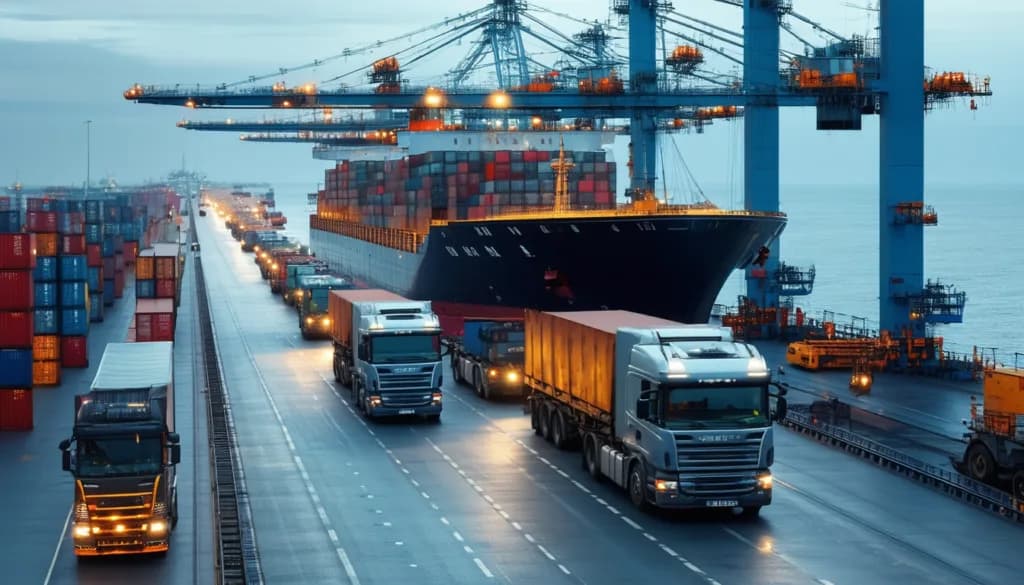
When goods move between defined inland points, GIT is usually the first cover to review. The main risks sit in loading damage, theft, hijacking, route diversions, collision loss, and unloading incidents. A business moving stock from a warehouse to a customer, from one branch to another, or from a supplier to a local site is usually dealing with an inland movement problem first.
Goods in transit insurance covers insured goods while insured goods move between defined points, subject to policy wording.
That wording matters. One policy may start at collection. Another may start after loading. One may end at first unloading. Another may continue until signed delivery. GIT is not a blanket answer because a truck is involved. It usually fits best when the risk sits in the inland leg and the policy follows that leg clearly from start to finish.
When does marine cargo apply instead?
Marine cargo usually becomes the stronger answer when the shipment stops behaving like a local delivery and starts behaving like a trade movement. That shift often appears when goods are imported, exported, moved through a port, placed into a multimodal chain, or carried through a route that extends beyond ordinary inland delivery.
The easiest mistake is to read marine cargo too narrowly. The name sounds as if it belongs only to the sea leg. Trade routes rarely behave that neatly. A shipment can move from supplier to depot, from depot to port, from port to vessel, from vessel to terminal, and from terminal to warehouse. A truck may carry part of that route, but the overall exposure can still belong to a marine cargo structure because the journey sits inside an import, export, or wider cargo chain.
The real trigger is the handover point, contract term, and route design
The better test sits in three places: the handover point, the contract term, and the route design.
The handover point matters because risk does not stay with one party just because the goods keep moving. A shipment can leave the seller’s premises and remain the seller’s responsibility for one stage of the route. Another shipment can leave the same kind of premises and shift to the buyer almost at once because the contract says so.
The contract term matters because FOB, CIF, EXW, and similar terms divide costs and risk in specific ways. A business cannot choose between GIT and marine cargo by looking only at the vehicle or destination. The route matters too. Very few commercial shipments travel in one uninterrupted line. A load may leave a supplier, stop at a consolidation point, move to a port, sit in handling, travel internationally, and continue inland again. Each shift can change the insurance answer.
Which policy fits domestic deliveries, imports, exports, and mixed movements?
A straightforward domestic delivery usually points first toward GIT. If a company is moving stock from a warehouse to stores in Pretoria, the main exposure usually sits in inland transport, loading, theft, accidental loss, and unloading. The route is local. The risks are local. In that setting, GIT usually provides the cleaner framework.
An import or export route usually points more strongly toward marine cargo. Once goods enter a chain shaped by customs, port handling, overseas carriage, or multimodal transit, the insurance question expands. The shipment is no longer only about a vehicle travelling from one point to another. It becomes a structured trade movement with more than one transfer point.
Mixed movements need the closest reading. A shipment may arrive under marine cargo conditions and continue inland under separate wording or an extended structure. This is where the wider Marine and Cargo discussion becomes useful. It is also where businesses often revisit Cargo Insurance, review Incoterms & Insurance Policies, and check how Imports & Exports affect the real route.
GIT can leave gaps when the full journey is misunderstood
GIT works well when the policy is used for the movement it is designed to cover. Problems usually begin when a business assumes one inland policy must stretch across every stage linked to the goods.
A common misunderstanding appears after arrival. Goods may travel under a marine cargo structure for the international leg, pass through handling or release, and continue inland by road. An operations team may see one smooth journey. Policy wording may see separate stages divided by a defined endpoint. If the original scope stops at discharge, terminal handover, customs release, or another named point, the next inland movement may sit outside the original cover unless the wording carries the goods further.
The same problem appears during pauses. A supplier route from Limpopo to a port may look like one clean road movement on a transport schedule, yet the commercial meaning of that leg depends on what happens next and who carried the risk at that stage.
How to choose between GIT and marine cargo before a claim tests the wording
The safest approach is to work through the route in the same order the goods will travel.
Identify the full route
Map the journey from first collection to final delivery. Include loading points, depots, port movement, post-arrival delivery, and any pauses that interrupt the route.
Identify the transfer point
Determine where responsibility moves from one party to another. Risk may shift at collection, at loading, at the port, after discharge, or only at final delivery.
Check the contract term
Test the route against the trade term. EXW, FOB, and CIF do not place the burden in the same place. Once the transfer point is clear, it becomes easier to judge whether the stage is mainly an inland transit issue, a marine cargo issue, or a combination of both.
Check limits and continuity
Read the wording for where cover starts, where it ends, and how it treats pauses, storage, and handling. Then decide whether one policy truly follows the whole movement or whether layered cover is the cleaner answer.
Closing Reflection
The shipment from the opening scene looked simple from the gate. A truck left, the documents travelled with it, and the movement appeared continuous. The real discipline sat elsewhere. Risk could move before the goods did. Responsibility could shift before delivery did. One route could contain several insurance questions disguised as one commercial task.
That is the practical difference between GIT and marine cargo. One usually answers the inland part of the journey. The other usually answers the wider trade part. Sometimes those answers sit neatly apart. Sometimes they meet in the middle. The better method is plain: trace the path, mark the handover, check the contract, and test the wording against the real movement of the goods.
You shouldn’t have to argue over which policy applies while a crushed pallet sits at the transfer yard. With Mont Blanc Financial Services you won’t.
Contact Mont Blanc Financial Services to match your shipment to the right cover, GIT, marine cargo, or both across one journey.
Before moving into common questions, keep one point in view: goods can travel in one visible journey while the insurance responsibility changes more than once underneath that same route.
For the bigger picture, start with our full guide to marine and cargo insurance.
Frequently Asked Questions
When does goods-in-transit insurance apply?
Goods-in-transit insurance usually applies to inland movement between defined points, and it is the first cover to review when goods travel by road within the country. The main risks it addresses are loading damage, theft, hijacking, route diversions, collision loss, and unloading incidents, the exposures of an inland journey. A business moving stock from a warehouse to a customer, from one branch to another, or from a supplier to a local site is usually dealing with an inland movement problem first, which is GIT’s territory. The cover responds while insured goods move between defined points, but the policy wording matters: one policy may start at collection and another only after loading, one may end at first unloading and another continue until signed delivery. GIT is not a blanket answer simply because a truck is involved; it fits best when the risk genuinely sits in the inland leg and the policy follows that leg clearly from start to finish.
When does marine cargo insurance apply instead?
Marine cargo insurance usually becomes the stronger answer when a shipment stops behaving like a local delivery and starts behaving like a trade movement. That shift typically appears when goods are imported, exported, moved through a port, placed into a multimodal chain, or carried along a route that extends beyond ordinary inland delivery. At that point the exposure is no longer simply an inland-leg problem but a broader trade-journey problem, which marine cargo cover is designed to address. The easiest mistake is to read marine cargo too narrowly, assuming from the name that it belongs only to the sea leg. Trade routes rarely behave that neatly: a single import movement may involve a sea voyage, port handling, and inland transport, and marine cargo cover can follow that whole journey rather than just the ocean portion. The practical signal is the character of the shipment, whether it is a local delivery or part of import, export, or multimodal trade.
What is the difference between GIT and marine cargo insurance?
The difference between goods-in-transit and marine cargo insurance lies in the kind of shipment exposure each is built for. GIT usually applies to inland movement between defined points, addressing the risks of a road journey within the country, loading, theft, hijacking, collision, unloading. Marine cargo usually applies to trade movement, import, export, port-linked, or multimodal journeys that extend beyond ordinary inland delivery. The distinction is not about whether a truck or a ship is involved, since both can feature in either, but about the character of the movement: a local delivery between two fixed inland points versus a broader trade journey crossing modes or borders. This matters because choosing cover by the wrong signal, assuming GIT because a truck is used, or assuming marine applies only to the sea leg, can leave a shipment matched to the wrong policy. The right approach is to identify whether the risk sits in an inland leg or in a wider trade movement, and to select the cover built for that exposure.
How do I know whether I need GIT or marine cargo cover?
Knowing whether you need goods-in-transit or marine cargo cover comes down to identifying the character of the shipment and where its risk genuinely sits. If the movement is an inland one between defined points, a warehouse to a customer, a branch to a branch, a supplier to a local site, the exposure is an inland-leg problem and GIT is usually the first cover to review. If the shipment is part of import or export trade, moves through a port, or runs through a multimodal chain extending beyond ordinary inland delivery, it behaves like a trade movement and marine cargo is usually the stronger answer. The key is not to choose by surface features such as the presence of a truck, but by the nature of the journey. It is also important to recognise that a single end-to-end shipment can involve both an inland leg and a trade leg, in which case the covers need to meet without a gap between them..

Nicola Iozzo
Founder & CEO, Mont Blanc Financial Services
Nicola has spent his career reading the policy wording most people skip, and writes here so you don't discover at claim stage what page 14 meant.
This blog is here to inform, not advise. Think of it as a guidebook, not a contract. For decisions affecting your world, have a chat with your broker or financial professional.
Mont Blanc Financial Services (PTY) Ltd. is an authorised financial services provider. FSP 8271