Unlocking Savings: The Diesel Rebate for Farmers
Diesel for a tractor, a harvester, or an irrigation pump never touches a public road, yet the levies built into its price help fund those roads and the Road Accident Fund. The diesel rebate exists to correct that imbalance, returning part of the levies on fuel used in qualifying off-road farming. Most farmers either do not claim it or claim it incorrectly, leaving money at the pump. That gap is paperwork most never interrogate.
What is the diesel rebate for farmers?
The diesel rebate for farmers is a South African Revenue Service mechanism allowing qualifying primary producers to reclaim part of the fuel levies, such as the Road Accident Fund levy, included in the price of diesel used in off-road agricultural operations. It recognises that farm machinery does not use public roads, and is governed by specific conditions.
Key Takeaways
- The diesel rebate lets qualifying farmers reclaim part of the fuel levies paid on diesel used in off-road agricultural operations, since farm machinery does not use public roads.
- It is administered by SARS under customs and excise legislation and carries specific eligibility conditions, registration requirements, and record-keeping obligations.
- Accurate logbooks and records of qualifying diesel use are central to a valid claim, and gaps in them are a common reason claims fail.
- The rules, forms, apportionment, and thresholds are detailed and subject to change, so current SARS requirements should be confirmed before claiming.
- Claiming correctly can return meaningful amounts on one of a farm’s largest operating costs, while claiming incorrectly risks rejection or penalties.
What Is the Diesel Rebate?

If you have ever stared at a diesel invoice and wondered why so much of your hard-earned cash disappears into government coffers, the answer lies in two words: fuel levies. Every litre you buy includes built-in costs such as the General Fuel Levy and the Road Accident Fund (RAF) levy, both intended to maintain public roads and cover accident-related claims.
Fair enough if you are driving on the highway, but when your diesel fuels a harvester, irrigation pump, or generator far from the nearest tar, the logic starts to leak like a cracked pipe. The diesel rebate is SARS’ way of plugging that gap.
Under Schedule 6, Part 3 of the Customs and Excise Act, farmers and other primary producers can reclaim a portion of the levies included in their fuel purchases when the diesel is used in qualifying off-road operations. It is not a refund on the diesel itself but on the levies folded into it. Think of it as a quiet thank you from the Treasury, not for paperwork but for keeping South Africa fed.
In essence:
- The rebate applies only to diesel used for primary production such as farming, fishing, or forestry.
- For agriculture, it covers work like planting, ploughing, harvesting, and irrigating.
- Diesel used for on-road transport (even a farm bakkie) does not qualify.
The rebate exists to ease the cost of running the machines powering the nation’s food supply. It is not a loophole. It is a lawful return to those who turn the soil and keep the economy alive.
Understanding Eligibility
The diesel rebate is not open to everyone who fills a tank. It was designed for primary producers, people whose work starts at the ground level of the economy. For farmers, this means operations linked directly to cultivating, irrigating, harvesting, or caring for livestock. It rewards the fuel that drives production, not transport or convenience.
To qualify, you must first be registered as a VAT vendor. Once registered, you then apply to SARS for inclusion in the diesel refund system. This involves completing a VAT101D form and providing supporting documents confirming your business activities. Registration turns you into a recognised “user” under the rebate scheme, a title that allows you to claim for qualifying diesel.
Eligibility also hinges on how and where the fuel is used. Only diesel consumed in off-road equipment, such as tractors, pumps, harvesters, and generators, counts toward the rebate. Anything that travels public roads: no matter how dusty and rural those roads may be, falls outside the net.
SARS pays close attention to record-keeping, and for good reason. Every litre claimed must be traceable through invoices, storage logs, and usage records. A well-kept logbook should show the date, amount, machine, and activity performed. Even small lapses can raise questions, so precision matters.
Environmental and safety compliance also plays a role. Diesel storage facilities must meet containment and fire-safety standards outlined by the Department of Agriculture, Land Reform and Rural Development (DALRRD). Proper infrastructure prevents spills, protects soil and groundwater, and signals that the farm operates responsibly.
When all of these pieces align, registration, records, and compliance, the rebate works exactly as intended. It becomes a partnership between responsible producers and a revenue system that recognises their essential contribution.
The Application Process – From Paperwork to Pay-back
Once you know you qualify, the next step is turning that eligibility into actual savings. The process may seem buried in forms, but it runs smoothly when you follow the steps in order.
Step 1: Register with SARS
Start by registering with SARS as a diesel rebate user. You will need to submit a DA 185 form along with supporting documents such as proof of identity, proof of farming activity, and evidence of compliance for your diesel storage facilities. Once your registration is approved, SARS issues a registration number. Keep it safe because every future claim depends on it.
Step 2: Keep Your Records in Order
Record-keeping begins the moment diesel reaches your tank. Keep every invoice showing the date of purchase, volume bought, and supplier details. Keep a logbook for usage as well, noting how each litre is used, which machine consumed it, and for what task. A simple notebook works, but digital records make life easier if SARS ever asks for proof.
Step 3: Submit Your Claim
Claims are made by submitting the DA 160 form, which details the diesel used in eligible farming activities during a given period. Attach copies of invoices and receipts. SARS allows up to two years from the purchase date to file a claim, so do not leave it to the last minute.
Step 4: File and Wait
You can submit the claim electronically or through a SARS branch. Electronic submission is faster and helps you track progress. Once accepted, the rebate amount appears as a credit on your VAT201 return, effectively reducing your VAT bill or increasing your refund.
Step 5: Store Your Documents
Keep all paperwork for at least five years. SARS conducts random audits to ensure compliance. Having complete, neatly organised records turns an audit from a nightmare into a short conversation.
When handled correctly, the process feels less like bureaucracy and more like routine farm management. You track your inputs, you record your outputs, and you keep evidence ready for review. The return may not arrive overnight, but when it does, it feels like diesel money coming home.
Mixed Use and Apportionment
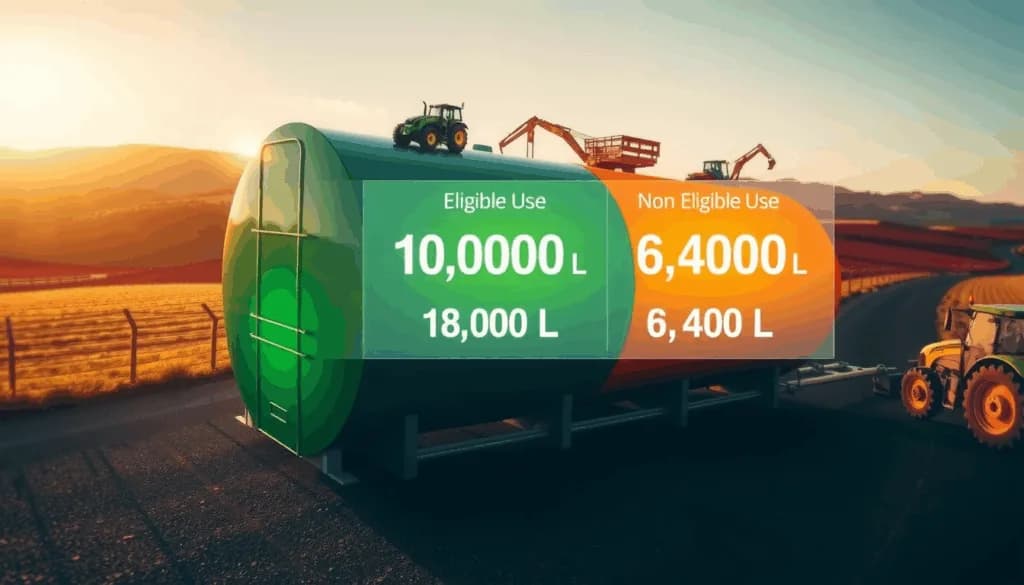
Not every litre of diesel on a farm runs a tractor. Some powers generators, some drives bakkies on public roads, and some might even go into machinery used by contractors. Not all use qualifies, SARS expects farmers to separate eligible litres from those that do not. This process is called apportionment and getting it right is essential for an accurate claim.
If you draw fuel from one tank for both eligible and non-eligible activities, you need to calculate how much diesel went where. The rebate covers only the portion used in off-road, primary production. Anything linked to road transport, staff movement, or other non-farming operations falls outside the claim.
Even once you identify your eligible litres, SARS applies an additional limitation: only 80% of that eligible diesel qualifies for the rebate.
Example:Your farm purchased 10 000 litres. After reviewing logs:
- 8 000 litres were used in tractors and pumps (qualifying use).
- 2 000 litres went to bakkies and generators for non-farming use.
Step 1: 10 000 – 2 000 = 8 000 litres eligible.Step 2: 8 000 × 80% = 6 400 litres claimable.
The rebate is calculated on those 6 400 litres. Keep detailed logs, especially when using shared tanks or mobile bowsers.
Benefits of the Diesel Rebate
For many farmers, the diesel rebate can feel like a drop in a very large fuel tank, but once you run the numbers, it becomes clear just how powerful this return can be. It is more than a tax adjustment; it is a financial relief valve built for the realities of farming life in South Africa.
Lower Operating Costs
Diesel expenses can consume a significant share of a farm’s annual budget. The rebate allows you to reclaim part of the levies hidden in those costs, reducing fuel expenses and easing cash flow pressure. Whether you are running five tractors or fifty, the difference adds up over a season.
Improved Profitability
Every rand saved on diesel can be redirected into something that grows value. Most farmers use the rebate to reinvest in irrigation systems, modern machinery, or better storage facilities. These improvements often lead to higher yields, greater efficiency, and stronger long-term margins.
Predictable Budgeting
The rebate is linked to fixed levy rates, which means it provides a measure of predictability. You can plan annual budgets more accurately because you know what percentage of your diesel expenditure can be recovered. In an industry where rain, prices, and politics can all shift overnight, predictability is a rare comfort.
Support for Sustainability
The rebate system encourages farmers to maintain compliant and environmentally responsible storage facilities. By investing in proper containment, you not only qualify for the rebate but also help protect groundwater and soil. It aligns profitability with responsibility, something modern agriculture can always use more of.
Strengthened Competitiveness
By lightening one of the heaviest input costs, the rebate keeps South African farmers competitive against imported goods and rising production costs abroad. It helps level the playing field for those working the land at home, giving them space to grow rather than merely survive.
In short, the diesel rebate is not simply about recovering money; it is about reinvesting it wisely. It keeps the wheels of agriculture turning and allows farmers to push forward with a little more confidence and a little less strain.
Compliance Quick-Check
Every rebate claim rests on compliance. Before submitting, confirm you have:
- VAT registration in the correct entity name.
- Diesel rebate registration (VAT101D approval).
- Valid invoices issued in your entity name.
- Comprehensive logs of usage and storage.
- Compliant fuel facilities meeting SARS record-keeping guidelines.
Avoid:
- Wrong names on invoices.
- Missing logs or unreconciled tanks.
- Road-use fuel claims.
- Late filing or poor archiving.
A simple system, updated weekly, is safer than a complicated one done in panic.
Appendix: Practical Templates and Tools
Diesel Purchase Register: record the date, supplier, invoice number, litres, price per litre, total, and whether proof is on file. Example: 2025/02/05, AgriFuel Depot, INV-4567, 5 000 litres at R25.40 per litre, R127 000, proof filed.
Usage Logbook: record the date, machine, task, hours, litres, field, and notes. Example: 2025/02/06, JD 6930, ploughing, 5 hours, 120 litres, North field, routine prep.
Storage Tracker: record the date, opening balance, fuel in, fuel out, closing balance, variance, and who checked it. Example: 2025/02/06, opening 3 000, in 5 000, out 2 800, closing 5 200, variance +200, checked by L. Nkosi.
Back up every record in cloud storage and one offline copy.
Common Misconceptions About the Diesel Rebate
Even though the diesel rebate has existed for years, many farmers still overlook it or misunderstand how it works. Some avoid it altogether because they have heard it is complicated or not worth the effort. Most of these beliefs are based on half-truths and clearing them up can make a real difference to your bottom line.
“It Is Too Complicated”
The application process does take effort, but it is not impossible. The key is consistent record-keeping. If you keep invoices, maintain a logbook, and understand where your diesel goes, you already have most of the work done. Once you register and submit your first claim, the process becomes routine.
“All Diesel Qualifies”
Not quite. Only diesel used in off-road, primary production activities qualifies for the rebate. Fuel burned by tractors, harvesters, and irrigation pumps counts. Diesel used in delivery vehicles, staff transport, or any road-going machinery does not. Think of the rebate as a refund for work done in the field, not on the highway.
“Small Farms Do Not Benefit”
Every litre counts. The rebate is proportional, meaning even small-scale producers can see meaningful savings. For a smaller operation, the rebate might cover maintenance costs or seed for the next planting. It is not about scale; it is about using the system correctly.
“The Rebate Is a Loophole”
The rebate is written into South African law. It is a legitimate programme designed to support primary producers who power the country’s food supply. SARS expects you to use it if you qualify, provided you comply with the rules and keep your records clean.
“Claims Always Get Rejected”
Rejections happen when paperwork is missing or fuel use cannot be verified. When documentation is complete and accurate, claims are usually processed without issue. Farmers who follow the process and submit on time rarely experience problems.
Clearing away these myths helps shift the rebate from a mystery to a manageable routine. Once you see how accessible it really is, you realise it is not red tape, it is reclaimed fuel money.
Important Deadlines and Timeframes
In farming, timing is everything. You sow too early, the frost bites. You sow too late, the rain forgets. The diesel rebate is no different. Missing a date can cost you real money, so it pays to know the timelines as well as you know your planting schedule.
Two-Year Claim Window
SARS allows you up to two years from the date of diesel purchase to submit your rebate claim. After that, the window closes, and any unclaimed fuel costs are gone for good. It may sound like plenty of time, but between planting, harvesting, and paperwork, two years can vanish quickly. The best habit is to claim quarterly or biannually, keeping your paperwork fresh and your refund flowing.
Keep Registration Up to Date
If your farming business changes hands, restructures, or expands into new operations, you must update your registration details with SARS. Outdated information can cause delays or even block your claim. Treat your SARS registration like your farm licence: it must always reflect reality.
Prepare for Audits
SARS conducts periodic audits to verify compliance with the rebate system. These audits are not personal; they are standard checks on record accuracy and fuel use. Keep your invoices, receipts, and logbooks accessible. Farmers who keep neat records rarely face trouble. The audit becomes a formality rather than a crisis.
File Storage
Hold on to all rebate documentation for at least five years. This includes purchase invoices, usage logs, claim forms, and correspondence with SARS. A digital copy stored safely online can protect you from paper damage or loss.
Staying ahead of deadlines turns the rebate into a reliable support system instead of a missed opportunity. The process rewards consistency, not speed. Submit on time, keep your records clean, and you will never have to chase a forgotten refund again.
How to Maximise Your Savings with the Diesel Rebate

Knowing you qualify for the diesel rebate is one thing. Using it wisely is another. With a few simple strategies, farmers can turn the rebate from a once-a-year bonus into a steady cash flow advantage.
Buy Diesel in Bulk
Whenever possible, buy in bulk. Larger purchases often come with better prices, and those savings multiply when the rebate is added on top. Bulk buying also reduces the number of invoices you need to manage, making the paperwork side easier when it comes time to claim.
Track Diesel Use with Precision
Keep detailed logs for every machine. Note the date, quantity used, and purpose. A well-maintained logbook not only strengthens your claim but also helps identify where diesel is wasted. Many farmers discover that careful tracking reduces consumption by showing how much fuel idles away in forgotten engines or inefficient routes.
Maintain Equipment Regularly
Engines running at peak efficiency burn less fuel. Regular servicing, clean filters, and proper calibration all contribute to reduced diesel consumption. Every litre saved stretches both your pocket and your rebate.
Invest in Smart Tools
There are now digital tools and mobile apps that simplify the rebate process. They track diesel usage automatically, generate reports, and keep receipts stored securely in the cloud. These systems can save hours of administrative work and remove human error from your records.
Claim Consistently
Waiting two years to submit claims might sound easier, but it slows your access to refunds and increases the chance of lost paperwork. Submitting quarterly keeps your cash flow steady and your documentation organised. It also prevents one massive mountain of admin at the end of the season.
Stay Audit-Ready
Treat every record as if SARS will check it. Store digital copies of all invoices, keep equipment logs updated, and file your claim forms neatly. When everything is in order, an audit is nothing more than a quick verification. The cleaner your system, the faster your refund.
Think of the Rebate as an Investment Tool
The rebate should never sit idle. Use the returned funds to reinvest in your farm, whether it is upgrading machinery, improving irrigation, or buying better-quality seed. The goal is to let the rebate feed future growth, not just fill a short-term gap.
Handled strategically, the rebate becomes more than a refund. It becomes part of a cycle where savings power reinvestment, efficiency increases, and profit grows. It is not about chasing money from SARS; it is about managing your resources so well that the system works for you.
Success Stories from South African Farmers
Sometimes the best way to see the value of the diesel rebate is through the stories of farmers who use it well. These are not corporate case studies or distant statistics. They are ordinary South Africans who turned their rebate into something tangible, proving how small percentages can make a big difference.
Free State Maize Farmer – Turning Savings into Growth
A mid-sized maize farmer in the Free State calculated that diesel costs were eating more than twenty percent of his seasonal budget. After learning about the rebate through a local co-op, he started claiming regularly and recovered a meaningful share of those costs each year. The savings funded a new irrigation system, which in turn increased his yield. Within three seasons, his overall production had grown enough to offset the cost of the new equipment. What began as a tax refund ended up as a farm upgrade.
KwaZulu-Natal Livestock Farmer – Reinvesting in Efficiency
A livestock farmer near Estcourt used her rebate to modernise her fleet of farm vehicles. She replaced older bakkies and tractors with more fuel-efficient models, cutting her diesel use by nearly fifteen percent. The rebate continued to offset part of her costs, and she used the long-term savings to expand her grazing lands. Her operation became leaner, greener, and more profitable without taking on new debt.
Western Cape Vegetable Grower – From Scepticism to Sustainability
A small-scale vegetable farmer outside Paarl once dismissed the rebate as too complicated for a one-person operation. After attending a workshop and keeping careful fuel logs for a season, she submitted her first claim and was surprised by the result. The savings covered her packaging costs for the next crop cycle. Over time, she invested those rebates into organic certification and drip irrigation. The shift attracted new buyers and boosted her reputation for sustainable produce.
Northern Cape Cooperative – Building Collective Value
A group of farmers in the Northern Cape took the rebate further by forming a cooperative to bulk-purchase diesel. Their combined buying power lowered the per-litre price, and each member claimed their rebate individually. The result was lower costs across the board and better cash flow for seasonal inputs. Their example spread across the district, proving that collaboration can multiply the rebate’s impact.
Each of these stories shows the same pattern: when farmers take the time to understand the rebate, track their diesel use, and reinvest their refunds, they gain more than financial relief. They gain control. The rebate becomes part of a bigger picture of planning, efficiency, and resilience, qualities every farm needs to thrive in South Africa’s unpredictable landscape.
Below are some questions frequently asked by the farmers we ensure.
Running a farm in South Africa is not for the faint-hearted. Between unpredictable weather, rising input costs, and the daily pressure to keep operations moving, every rand counts. The diesel rebate exists to help lighten that load. It is not a favour or a loophole. It is a system built to reward the hands that keep food on the nation’s tables.
When used properly, the rebate does more than refund a few cents per litre. It creates space in a farm’s budget for investment, stability, and growth. Many farmers use it to upgrade equipment, expand operations, or simply maintain healthy cash flow during tight months. In a world where costs are always climbing, the rebate brings a small measure of relief and fairness.
Claiming it successfully depends on three things: clean records, timely submissions, and a clear understanding of what qualifies. The process can seem daunting at first, but it becomes part of your regular financial rhythm once you’ve done it correctly a few times. It is one of the few areas in business where diligence pays you back directly.
If you are a farmer who has never claimed before, now is the time to start. Review your diesel use, check your VAT registration, and speak to a professional who understands how the rebate works. With the right help, you can turn paperwork into payment and effort into efficiency.
Why the Diesel Rebate Matters to Your Insurance
The diesel rebate focuses on recovering fuel levies, but it also has a quiet influence on a farmer’s overall financial risk, including insurance. The rebate improves liquidity, reduces fuel-related losses, and provides clear visibility into diesel usage, all of which strengthen a farmer’s risk profile.
When your records are organised for SARS, you are also protecting yourself during an insurance claim. Accurate logbooks, fuel inventories, and compliance certificates create an auditable paper trail insurers respect. These records demonstrate good governance and proper asset management, both of which can influence premiums and claim outcomes positively.
At Mont Blanc Financial Services, we have seen how a well-run rebate process supports more than cash flow. It encourages better underwriting, faster claim handling, and greater confidence from insurers who value operational transparency. In simple terms, clean records not only recover money but also protect your business when it matters most.
By managing both financial and insurance needs in one place, Mont Blanc helps farmers see the full picture. The diesel rebate strengthens your financial base, and solid insurance keeps it protected. Together they ensure your business stays prepared, compliant, and claims ready.
Ready to Claim What’s Yours?
You work hard for every harvest, every litre, and every rand. The diesel rebate is not a gift; it is money already yours, waiting to be claimed. The key is knowing how to do it right: clean records, proper registration, and a process that keeps you compliant while saving you costs.
“You shouldn’t have to leave money at the pump or carry farm risk you never properly covered. With Mont Blanc Financial Services you won’t.
Contact Mont Blanc Financial Services to make sure your farm’s cover is structured soundly alongside the other costs and mechanisms that keep the operation viable.”
This article is part of our complete guide to agricultural insurance.
Frequently Asked Questions
What is the diesel rebate for farmers in South Africa?
The diesel rebate for farmers in South Africa is a mechanism administered by SARS that allows qualifying primary producers to reclaim a portion of the fuel levies included in the price of diesel used off-road. Every litre of diesel carries built-in levies, including the general fuel levy and the Road Accident Fund levy, which are intended to fund public roads and road-accident claims. The logic of the rebate is that farm machinery, tractors, harvesters, irrigation pumps, generators, operates away from public roads, so charging it the full road-related levies is an imbalance the rebate corrects. Qualifying farmers can therefore recover part of those levies on diesel used in eligible agricultural operations. The rebate is governed by specific legislation and conditions, and it is one of the few financial mechanisms designed specifically to ease the operating costs of food producers. Because diesel is among a farm’s largest expenses, the rebate can return meaningful sums, but only where the operation qualifies and the claim is made correctly under the applicable rules.
Who qualifies for the diesel rebate for farmers in South Africa?
Qualification for the diesel rebate for farmers in South Africa depends on being a primary producer using diesel in eligible off-road agricultural activities, subject to SARS’s specific conditions. The rebate is aimed at those engaged in genuine farming operations where the diesel powers machinery and equipment used in production rather than on public roads. Beyond the broad principle, SARS sets detailed eligibility and registration requirements that determine who can claim and how, and these conditions are precise rather than general. Because the exact registration process, qualifying activities, and documentation requirements are detailed and have been subject to change, a farmer should confirm the current rules directly with SARS rather than relying on a general description. Meeting the eligibility criteria is only the first step; the claim must then be supported by proper records of qualifying use. The practical position is that many farming operations qualify in principle, but qualification in practice depends on satisfying SARS’s specific requirements and maintaining the records that substantiate the claim. Confirming current eligibility before claiming is essential.
How do farmers claim the diesel rebate in South Africa?
Farmers claim the diesel rebate in South Africa through SARS, following a registration and claiming process supported by detailed records of qualifying diesel use. In broad terms, an eligible producer must register appropriately with SARS and then submit claims that account for the diesel used in qualifying off-road operations, distinguishing it from any non-qualifying use. Accurate record-keeping is central: logbooks and records showing how much diesel was used, and for which eligible activities, form the basis of a valid claim, and gaps or inconsistencies in those records are a common reason claims are reduced or rejected. The specific forms, registration steps, apportionment rules, and time limits that apply are detailed and have been subject to change, so the exact procedure should be confirmed against current SARS guidance before claiming. Because the tax detail is high-stakes, an error can be costly, many farmers work with a tax professional to ensure the claim is correct. The reliable principle is that a successful claim rests on eligibility plus thorough, accurate records of qualifying use.
How does the diesel rebate for farmers relate to farm insurance?
The diesel rebate and farm insurance are separate mechanisms, but both are part of managing a farm’s financial resilience, which is where they connect. The rebate reduces one of a farm’s largest operating costs by recovering levies on off-road diesel, improving cash flow, while insurance protects the farm’s assets and income against the perils that threaten them. Neither replaces the other, and the rebate is a tax matter rather than a form of cover. The link is that sound farm management involves both controlling costs and protecting against risk, and a well-run operation attends to each. A farmer focused only on cover might overlook a legitimate saving like the rebate, while one focused only on cost might underinsure. The broader point is that the financial health of a farming operation depends on managing the full picture, costs, tax mechanisms, and risk cover, in a coordinated way. The rebate and insurance address different parts of that picture, and treating both as elements of the same financial strategy serves the operation better than handling either in isolation.

Nicola Iozzo
Founder & CEO, Mont Blanc Financial Services
Nicola has spent his career reading the policy wording most people skip, and writes here so you don't discover at claim stage what page 14 meant.
This blog is here to inform, not advise. Think of it as a guidebook, not a contract. For decisions affecting your world, have a chat with your broker or financial professional.
Mont Blanc Financial Services (PTY) Ltd. is an authorised financial services provider. FSP 8271