Business Insurance Policy Terms & Conditions Explained
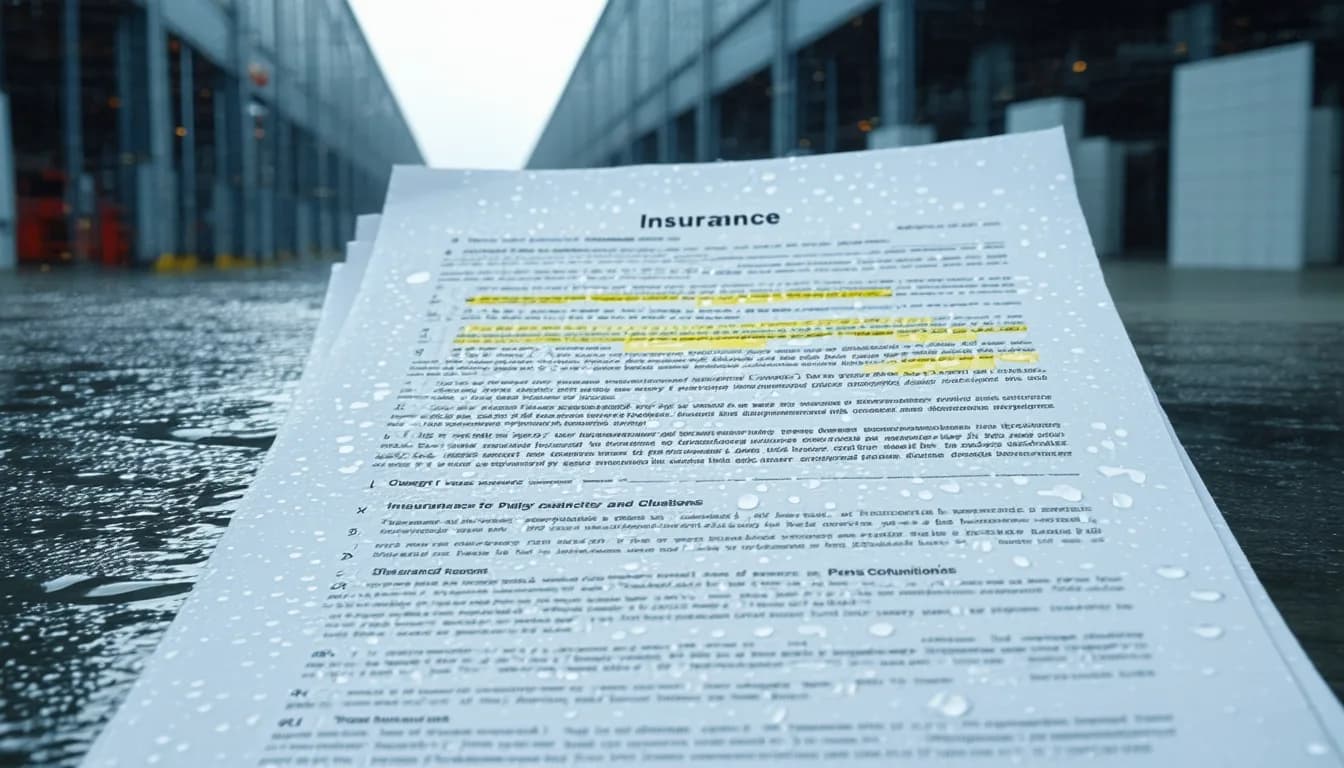
A policy folder only earns attention once an incident drags its fine print into daylight, a delivery driver reversing into a loading-bay door, rain across a storeroom floor, a night manager turning pages with wet fingers to find the security clause, the stock-records note, the stapled endorsement. By morning the assessor wants photos, invoices, and the schedule. The terms and conditions were the rulebook all along; the gap is that most owners meet them at exactly the wrong moment.
What are business insurance policy terms and conditions?
Business insurance policy terms and conditions are the contract rules attached to a policy. They define cover, list exclusions, set the policyholder’s duties, explain the claim steps, and shape payment limits, excesses, and endorsements. The schedule, the wording, and any endorsements operate together as the rulebook, taking precedence over any sales summary or assumption about what the cover provides.
Key Takeaways
- Policy terms and conditions govern cover through rules, limits, exclusions, and claim duties, and sit above any sales summary or hopeful memory.
- The schedule, the wording, and any endorsements should be read together before a loss occurs, since each shapes how the cover responds.
- Exclusions remove cover, conditions test access to cover, and excesses reduce the settlement value, three distinct mechanisms within one policy.
- Each section can carry its own separate triggers, proof rules, limits, and exclusions, so one may respond while another does not.
- Renewal review should follow business change, new stock, altered premises, or new contractual risk, so the cover keeps pace with the operation.
Business Insurance Policy Terms and Conditions Set the Rules of Cover

A policy can look tidy on page 1 and turn prickly by page 14. The schedule gives names, sums insured, sections of cover, and time periods. The wording brings muscle to those labels. Endorsements then walk in with muddy boots and change parts of both. An insurer’s business policy wording often states cover applies subject to terms, exceptions, conditions, and premium payment, which places the rulebook above any sales summary or hopeful memory.
For any company reading its policy after purchase, policy terms and conditions are less decorative than curtains and more decisive than a polite email chain. A fire section, theft section, or liability section can each carry separate triggers, proof rules, limits, and exclusions. One section may respond; another may sit with folded arms. A policy schedule without wording is a map without street names.
Business Insurance often gets discussed as a single purchase yet cover usually works as a set of linked promises, each with limits and rules. A stock claim may depend on stock records. A burglary claim may depend on forcible entry wording or alarm conditions. A business interruption claim may depend on a material damage trigger first. The contract does not reward guesswork. The contract rewards a close read before the forklifts start clattering and before the rain finds a weak roof seam.
Policy terms and conditions form the operating rules attached to each insured risk, with the schedule, wording, and endorsements read together as one contract.
What Business Owners Should Check Before a Claim Happens
A policy often resembles a hotel brochure until one reads the parts in smaller type. Then the place starts resembling a boarding school with rules on doors, windows, records, declarations, and curfews. None of those rules are for decorating the page. Each rule points to a claim question.
Check the insured property and values
The schedule should match current buildings, contents, machinery, stock, and revenue figures. Underinsurance can reduce settlement through average calculations where wording applies. A generous estimate scribbled on a renewal form can age badly by quarter-end.
Check security and protection duties
Alarm clauses, burglar bars, locks, firefighting equipment, and maintenance duties deserve a careful read. A claim file can pivot from damage proof to compliance proof in one afternoon. Security wording often asks not only what broke, but also which protection measure applied before the breakage.
Check disclosure and description accuracy
Business activity, premises use, stock type, and hazardous processes need accurate description. A bakery described as a café may sound innocent until ovens, gas lines, and production volumes enter the room. An insurer prices risk on disclosed facts, not on hopeful simplification.
Check claim records
Invoices, asset registers, stock counts, repair quotes, photos, and incident reports should sit where staff can retrieve them without archaeology. Good records strengthen Business Insurance Claims long before a loss adjuster arrives. Records also reduce the habit of arguing from memory, a habit with poor courtroom energy.
How Excesses, Exclusions and Conditions Change the Outcome
Three contract tools often travel in one untidy bundle in everyday conversation. The bundle then causes trouble.
An exclusion removes cover for a listed event, circumstance, or category. If the wording excludes wear and tear, gradual deterioration, defective workmanship, or dishonest acts by selected persons, cover stops before calculation starts. No excess fixes an excluded event. No persuasive shrug revives one either. Standard business policy wording usually sets out general exceptions, conditions, and limits in separate parts, which shows insurers treat each tool as a different lever.
A condition sets a rule attached to cover. Premium payment, risk management measures, claim notification, cooperation, safeguarding damaged property, and proof submission often sit here. A condition can affect whether cover responds, whether cover reduces, or whether investigation slows while missing information gets chased down.
An excess changes the amount payable after cover applies. If a policy covers storm damage with a R10,000 excess, the policy still responds. The payment simply starts lower. Many readers blend excess and exclusion into one gloomy blob. The contract does not. An excess trims payment. An exclusion removes payment. A condition tests access to payment.
In a burst pipe example, part of the damage may be covered, a gradual leak may sit outside cover, and a policy excess may still reduce the final settlement on the covered portion. Excess and Deductibles deserve separate attention for this reason. A reader treating those terms as interchangeable may enter a claim discussion on the wrong foot and spend two days arguing with the wrong paragraph.
When Policy Terms and Conditions Break Cover
Most claim disputes do not arrive wearing a villain’s cloak. Many start with a smaller problem: a missed fact, an old schedule, an unpaid premium, a security warranty, or a notice period treated with too much optimism. The wording then steps in like a school registrar and starts checking names against the list.
In South Africa, insurance supervision sits within a framework shaped by the framework and insurance legislation such as the insurance legislation. Public guidance and regulatory material do not decide a private claim on their own, yet they confirm the environment in which insurers disclose rules, administer products, and face conduct oversight.
Non-disclosure can damage cover when omitted facts were material to underwriting. A wrong business description can do similar damage. Late premium payment can suspend cover where wording says so. Late notification can hamper investigation and complicate validation. Unsupported amounts can trim settlement even where the event itself falls within cover.
Policy terms and conditions break cover in two common ways. First, an exclusion fits the facts. Second, a condition was not met. The difference carries weight in a legal matter, because the remedy, argument, and document trail may differ. A reader hunting only for the word “covered” may miss the sentence which changed the outcome five lines later. The Right Insurance Policy helps at placement stage, but clean wording review still needs to happen after purchase and again at renewal.
How to Read the Fine Print Without Missing the Commercial Risk
A policy should be read in sequence, not in panic. Panic reads one sentence, misses three definitions, then forms a conclusion with the confidence of a man assembling a bookshelf upside down.
Start with the schedule. Confirm insured names, premises, insured sections, limits, and period of insurance. Then move to definitions. Defined words can act like small hinges on large doors. “Business hours,” “burglary,” “money,” “employee,” or “damage” may carry narrow meanings. After definitions, read operative clauses for each section. Those clauses describe what cover responds to and under which trigger.
Next, read exclusions and endorsements. Endorsements can amend standard wording and often do so with little ceremony. A polite heading can conceal a meaningful shift in cover. Then read general conditions and claims procedures. Notification timing, proof requirements, salvage duties, cooperation duties, and premium rules usually sit here.
Commercial insurers often note cover can be customised across business risks, while formal wording and schedules govern the final contract position. Customisation sounds generous, yet custom cover also creates custom traps for lazy reading.
The practical aim is simple. Match each major risk in the business to a section, then match each section to limits, exclusions, conditions, and records needed at claim stage. A policy read in this order gives management a working document, not a ceremonial one.
Some risks hide in the debtor's book, which is where cover for unpaid invoices does its work.
Closing Reflection
A policy earns value when staff can read it before trouble arrives, not while standing in a puddle with a torch and a claims number. Helpful review turns vague reassurance into named limits, named duties, and named proof.
A policy needs disciplined reading, current facts, and records which match the business on the ground. Where wording feels narrow, outdated, or oddly stitched together, a review can fix the gap before a client, landlord, or bank tests the weak point. Fine print rarely causes drama on an ordinary Tuesday. Fine print prefers the hour after an ordinary Tuesday has ended badly.
You shouldn’t have to review current wording against actual operations, with Mont Blanc you won’t.
Call Mont Blanc and we will review your policy with you.
Common questions usually begin after the first read, when familiar words start carrying legal weight and operational cost.
It sits within our broader guide to general business insurance.
Frequently Asked Questions
What are the terms and conditions of a business insurance policy?
The terms and conditions of a business insurance policy are the contract rules that govern how the cover works, made up of several connected documents. The schedule gives the specifics: the insured’s name, the sums insured, the sections of cover, and the periods. The wording then defines what those labels mean, setting out the cover, the exclusions, the duties placed on the policyholder, the claim steps, and the limits and excesses. Endorsements are amendments that change parts of the schedule or wording, sometimes significantly. Together these define cover, list exclusions, set duties, explain how to claim, and shape what is paid. Crucially, the wording typically states that cover applies subject to its terms, exceptions, conditions, and payment of the premium, which places this rulebook above any sales summary or recollection of what was promised. A schedule without the wording is a map without street names. Reading all the documents together, before any loss, is what lets a business understand the rules its cover actually runs on.
What is the difference between exclusions, conditions, and excesses?
Exclusions, conditions, and excesses are three distinct mechanisms within a business insurance policy, and each affects cover differently. Exclusions remove cover: they describe losses or circumstances the policy will not pay for at all, so a loss falling within an exclusion is simply outside the cover regardless of the rest of the policy. Conditions test access to cover: they are requirements the policyholder must meet, such as maintaining specified security or keeping stock records, and failing to meet a condition can prejudice or invalidate a claim that would otherwise have been covered. Excesses reduce the settlement value: the excess is the portion of each claim the policyholder bears, deducted from what the insurer pays. Understanding the difference matters because they operate at different points: an exclusion decides whether the loss is covered at all, a condition decides whether the policyholder has preserved their access to that cover, and an excess decides how much of a covered, accessible claim is actually paid.
Why must the schedule, wording, and endorsements be read together?
The schedule, wording, and endorsements must be read together because each performs a different job, and reading one without the others leaves a misleading picture of the cover. The schedule lists the specifics, names, sums insured, sections, and periods, but it does not explain what those items mean or how they respond. The wording supplies that meaning, defining the cover, the exclusions, the duties, the claim rules, and the limits, giving substance to the schedule’s labels. Endorsements then amend parts of the schedule or wording, and because they can change cover materially, ignoring them can leave a policyholder relying on terms that have since been altered. A schedule read alone is a map without street names; the wording read without the schedule lacks the specifics; and either read without the endorsements may be out of date. Only together do they show what is actually covered, to what limit, on what conditions, and with what amendments.How can a business strengthen its position under its policy terms?A business strengthens its position under its policy terms by attending to disclosure, values, records, and review, the practical factors that determine how well the cover responds. Accurate disclosure matters because the cover is granted on the basis of the information given, and inaccurate or incomplete disclosure can undermine a claim. Keeping insured values current ensures the sums insured reflect what assets would actually cost to replace, avoiding the underinsurance that reduces settlements. Maintaining usable records, invoices, asset lists, evidence of stock, supports a claim and speeds the assessor’s review, since claims are tested against the documentation available. Beyond these, renewal review keeps the policy aligned with the business: as stock changes, premises alter, or new contractual risks arise, the cover should be reviewed so it still matches the operation. These steps do not change the terms themselves, but they put the business in the strongest position to satisfy them when a loss occurs.

Nicola Iozzo
Founder & CEO, Mont Blanc Financial Services
Nicola has spent his career reading the policy wording most people skip, and writes here so you don't discover at claim stage what page 14 meant.
This blog is here to inform, not advise. Think of it as a guidebook, not a contract. For decisions affecting your world, have a chat with your broker or financial professional.
Mont Blanc Financial Services (PTY) Ltd. is an authorised financial services provider. FSP 8271