Load Consolidation for Transporters Through the Road Freight Association

Combining several clients’ loads onto one truck looks like obvious efficiency, and most of the time it is. What changes underneath is the risk: one trailer now carries multiple owners’ goods, multiple liabilities, and a claims picture far more tangled than a single-consignment trip. The saving is visible at dispatch; the exposure shows only at claim stage, when a loss must be apportioned across consignments. That gap is where consolidation goes wrong.
What is load consolidation for transporters?
Load consolidation for transporters is the practice of combining multiple smaller loads, often from different clients, into a single truck to improve efficiency. Instead of running half-empty vehicles, transporters group consignments with similar destinations into one trip. It reduces cost and kilometres, but it also alters the operator’s risk profile, goods-in-transit exposure, and liability across multiple consignments.
Key Takeaways
- Load consolidation combines multiple smaller loads into one truck to cut cost, fuel, and unnecessary trips, and is a normal tool when done properly.
- It changes the operator’s risk profile, goods-in-transit behaviour, and liability exposure in ways many operators only discover at claim stage.
- Mixing incompatible load types on one trailer is a common failure, since goods that should not share space can damage one another.
- When a consolidated load suffers a partial loss, apportioning the claim across different clients’ consignments complicates and slows settlement.
- Clear documentation and declarations per consignment are what keep liability and cover workable on a consolidated trip.
What Load Consolidation Means
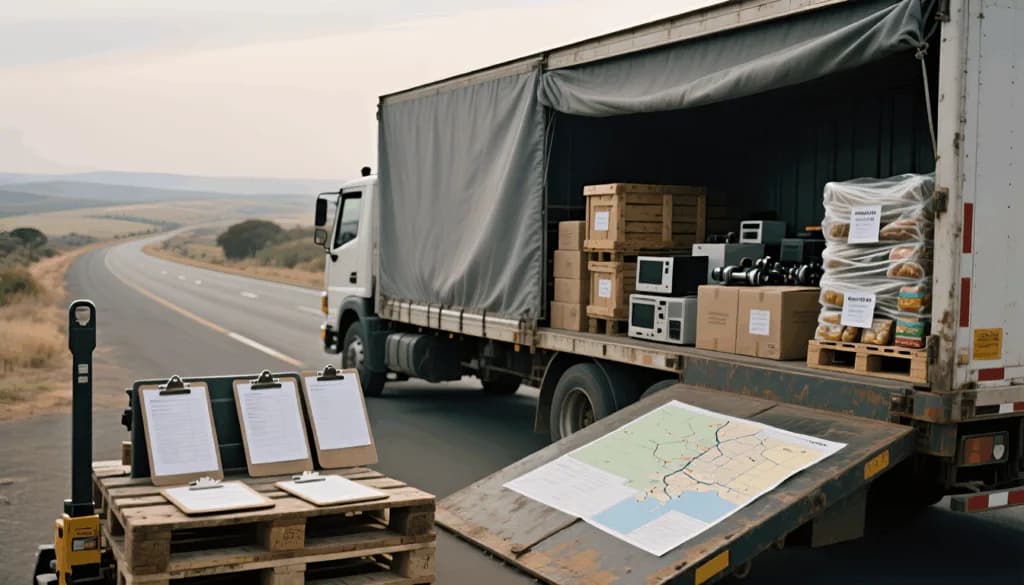
Load consolidation is the practice of combining multiple smaller loads into one truck to maximise efficiency. Instead of sending half empty vehicles across the country, transporters group loads with similar destinations and deliver them in one consolidated trip.
On a good day, it reduces costs, fuel consumption, kilometres travelled and unnecessary trips.On a bad day, it mixes load types that should never share a trailer, confuses liability and complicates claims.
Most transporters do not consolidate for fun. They do it because clients want cheaper transport, faster delivery or shared logistics. In an economy where everyone wants more for less, consolidation is the expected solution. But it must be done with proper understanding of the risk.
The Role of the Road Freight Association (RFA)
The RFA is South Africa’s primary authority on industry standards, safety practices, compliance guidelines, and operational ethics in freight movement. Their guidance on consolidation covers:
- safety requirements
- loading procedures
- client communication
- route planning
- cargo compatibility
- claims handling expectations
- container and trailer preparation
- documentation and declarations
The RFA encourages consolidation when it is done safely and discourages it when it poses avoidable risk. Their guidelines exist to keep transporters out of avoidable trouble.
The RFA has one simple principle that always holds true:Risk increases when load visibility decreases.
This is especially true when multiple clients’ goods sit side by side in the same space.
Why Transporters Consolidate Loads
There are good reasons consolidation is common:
- fewer trips
- reduced fuel costs
- optimised routes
- higher truck utilisation
- increased revenue per kilometre
- clients share costs
- predictable delivery windows
- reduced idle time
Consolidation is smart business. But smart business still needs smart protection, because merging three loads into one does not merge their risk. It multiplies it.
How Load Consolidation Increases Risk
Transporters often believe consolidation reduces risk because everything is on one truck. Unfortunately, insurers see the opposite. More clients, more goods, more variables, and more handling equal higher cumulative risk.
Let us break down how.
1. Increased Theft and Pilferage Risk
Mixed loads attract unwanted attention.A hijacker does not care about biscuits.But he cares a lot about electronics and tyres.
When high value goods travel with low value goods, the entire load becomes high value.This pushes up your risk rating instantly.
Insurers treat consolidated loads as a single exposure.This means R200,000 worth of TVs mixed with R20,000 worth of flour becomes a R220,000 target.
2. Cargo Compatibility Problems
Some goods should never sit together.For example:
- Strong scented goods next to textiles
- Delicate electronics next to shifting timber
- Temperature sensitive goods next to ambient goods
- Liquids next to absorbent goods
One client’s load can damage another client’s stock through no fault of the transporter.Congratulations. You become the referee in a blame match.
3. Higher Claims Complexity
If something happens, insurers must separate:
- what was damaged
- who owned what
- which client declared which value
- how each item was packed
- which invoice applies
- which consignment note matches which pallet
If this sounds like fun, it is not.Claims become longer, slower, and more complicated, especially if documentation was rushed.
4. Mixed Route Stops Increase Exposure
Consolidated loads require multiple stops at different points.Each stop increases risk, especially when drivers:
- park in unsecured areas
- open containers publicly
- expose high value goods accidentally
- wait for clients who are late
- load or offload without supervision
One wrong stop can compromise the entire load.
5. Client Disputes Multiply
If stock arrives damaged, clients want answers.If multiple clients share a space, nobody admits fault.The transporter becomes the default target because you are the common link.
Without proper GIT alignment, you stand alone in the dispute.
How Load Consolidation Affects Goods in Transit Insurance
GIT cover does not vanish during consolidation, but it behaves differently.GIT was created for loads with clear ownership, consistent packaging, and predictable routes. Consolidation breaks that simplicity.
Here is how consolidation changes your cover.
1. All Goods Must Be Declared Correctly
Insurers expect full transparency.If you are transporting electronics but you declare “general stock”, the insurer may deny the entire claim even if only the electronics are lost.
Mixed loads require precise declarations.
2. High Value Items Increase the Entire Load Value
Insurers calculate risk on the total exposure, not the individual pallets.One high value client affects all other clients.
This often surprises small operators.
3. Wrong Packaging Can Void Cover
If one client packs poorly and the goods damage another client’s goods, insurers may decline the claim unless the policy specifically extends to this risk.
Transporters must request packing declarations from every client.
4. Some Load Types Cannot Legally or Safely Be Consolidated
Insurers may not cover certain load combinations, such as:
- fuel with food
- chemicals with consumer goods
- flammable goods with electronics
- temperature sensitive goods with general freight
Consolidation is not simply a logistics decision.It is an insurance decision by extension.
5. Values Must Match Invoices
GIT pays based on declared values.If the values are wrong, underdeclared or unverified, disputes begin immediately.
Mixed loads multiply documentation risk.
How Consolidation Affects Claims Handling
Claims involving consolidated loads become detective work.The loss adjuster must prove:
- where the damage occurred
- whether packaging contributed
- whether the load order caused the damage
- whether incompatible goods were placed together
- whether declarations were correct
- whether proper loading procedures were followed
- whether the driver stopped in a safe area
- whether each client’s paperwork matches the actual goods
This process is slower and more detailed than single load claims.
One small mistake can ripple across multiple clients.
The RFA View on Consolidation
The Road Freight Association encourages consolidation only when:
- the goods are compatible
- the packaging is sufficient
- the paperwork is accurate
- the route is planned
- the driver is briefed
- clients understand the risks
- the transporter maintains proper documentation
- insurance aligns with operations
The RFA’s job is not to stop consolidation.It is to stop bad consolidation.
Consolidation should be strategic, not improvised.
How to Consolidate Loads the Right Way (According to Insurance Logic)
If you want to consolidate without risking a horror story, follow these guidelines.
1. Understand Each Client’s Cargo Properly
Ask:
- what it is
- how it is packed
- its value
- its sensitivity
- its stability
- its theft risk
Never load “mystery pallets”.
2. Group by Compatibility, Not Convenience
Similar goods should travel together.This reduces disputes.It also reduces loss severity.
3. Separate High Value Stock
High value items can be:
- strapped separately
- containerised
- placed closest to the door for faster offloading
- isolated inside the trailer
Do not mix a R500,000 pallet of electronics with 22 pallets of cleaning products and hope they become friends.
4. Maintain Documentation Like Your Business Depends On It
Because it does.
You need:
- separate consignment notes
- separate load lists
- separate invoices
- clear pallet labels
- clear compartments
GIT is documentation driven.Good paperwork equals good protection.
5. Control Route and Stop Behaviour
Drivers must:
- stop only at authorised points
- avoid exposing the load
- avoid informal parking
- avoid unnecessary detours
- avoid opening containers without supervision
Every stop is an opportunity for criminals or accidental damage.
6. Communicate With Clients
Clients must understand consolidation.Some goods do not want neighbours.Some clients do not want neighbours.Transparency prevents disputes.
Common Mistakes in Load Consolidation
These are the mistakes that create avoidable losses:
Consolidation saves money only when done carefully
The MBFS Approach to Consolidation and GIT
We help clients consolidate safely by:
- reviewing load types
- checking declarations
- advising on packaging risk
- checking route exposure
- ensuring GIT matches the operation
- adjusting cover for mixed loads
- ensuring drivers understand conditions
- aligning consolidation with real risk
- advising on RFA best practice
- supporting claims with proper documentation
Transporters often do consolidation first and worry about insurance later.We fix that.We make sure your cover matches your realities, not your assumptions.
We do this because We Care.And because you deserve a policy that actually pays when something goes wrong.
For the bigger picture, start with our full guide to trucking insurance.
Frequently Asked Questions
What is load consolidation for transporters?
Load consolidation for transporters is the practice of combining several smaller loads into a single truck to improve efficiency, often grouping consignments from different clients that share a destination or route. Rather than running half-empty vehicles across the country, the operator fills one trailer and makes a single trip, which reduces fuel, kilometres, and cost. It is a normal and sensible operational tool used across the industry, driven by clients wanting cheaper, faster, or shared transport. The complication is that consolidation changes the risk: one truck now carries multiple owners’ goods, which alters the operator’s liability and the way goods-in-transit cover responds. On a well-managed trip the efficiency gains are real. On a poorly managed one, incompatible loads share a trailer, liability blurs across consignments, and a single incident produces a tangled claim. The tool itself is sound; the outcome depends on how carefully it is executed. Understanding that consolidation shifts the risk profile, not just the logistics, is the starting point for doing it safely.
How does load consolidation for transporters affect insurance?
Load consolidation affects insurance by changing the operator’s goods-in-transit exposure and complicating liability across multiple consignments. When one truck carries goods belonging to several clients, a single loss event, theft, an accident, a fire, no longer involves one owner and one claim but several, each with its own value and documentation. Apportioning the loss across consignments is more complex than settling a single-client load, which can slow the claim and create disputes over which goods were affected and to what extent. The operator’s liability also broadens, since they are now responsible to multiple parties on the same trip. Goods-in-transit cover still applies, but the way it responds depends on clear records of what was carried for whom. This is why documentation per consignment matters so much on consolidated loads: it is what allows the claim to be untangled. An operator who consolidates without proper declarations can find the cover difficult to apply when a partial loss has to be divided among several clients.
What are the risks of load consolidation for transporters?
The main risks of load consolidation for transporters are incompatible cargo, blurred liability, and complicated claims. Mixing load types that should not share a trailer is a frequent failure: goods that react badly to proximity, or where one consignment can physically damage another, create losses that careful planning would have avoided. Liability becomes harder to manage because a single trip now carries obligations to several clients at once, so one incident can trigger multiple claims. Those claims are then complicated to settle, since a partial loss must be apportioned across different owners’ goods, each with its own value and documentation, which slows the process and invites dispute. Poor documentation magnifies all of these, leaving the operator unable to show clearly what was carried for whom. The risks are not a reason to avoid consolidation, which remains efficient and widely used, but a reason to execute it with discipline: compatible loads, clear declarations, and proper records. Done carelessly, the efficiency gain is outweighed by the claim that follows.
How can transporters consolidate loads safely?
Transporters can consolidate loads safely by following established industry guidance on loading, cargo compatibility, and documentation. The essentials are checking that load types are compatible before combining them, so goods cannot damage one another in transit; planning loading procedures and routes properly; and maintaining clear documentation and declarations for each consignment, which is what allows liability and any claim to be managed cleanly. Communicating with clients about how their goods are being carried also reduces disputes later. Industry bodies that set freight standards provide guidance covering exactly these areas, safety requirements, loading, cargo compatibility, documentation, and claims handling, and following that guidance keeps an operator out of avoidable trouble. The specific recommendations should be confirmed against the relevant body’s current published material rather than assumed. The underlying principle is that consolidation is safe when it is deliberate: compatible cargo, proper preparation, and thorough records. The efficiency it offers is real, but it depends on the operator treating the added complexity seriously rather than simply filling the trailer.
Closing Thoughts: Load Consolidation Is a Tool, Not a Shortcut
In the right hands, consolidation saves time, money and fuel.In the wrong hands, it creates disputes, losses, and frustration.
Consolidation is safe when:
- goods are compatible
- declarations are correct
- documentation is disciplined
- routes are planned
- GIT matches the load
- drivers understand the operational rules
- clients know how the process works
“You shouldn’t have to untangle a multi-client claim with no clear record of what was on the truck. With Mont Blanc Financial Services you won’t.
Contact Mont Blanc Financial Services to make sure your goods-in-transit cover and documentation hold up when loads are consolidated.”

Nicola Iozzo
Founder & CEO, Mont Blanc Financial Services
Nicola has spent his career reading the policy wording most people skip, and writes here so you don't discover at claim stage what page 14 meant.
This blog is here to inform, not advise. Think of it as a guidebook, not a contract. For decisions affecting your world, have a chat with your broker or financial professional.
Mont Blanc Financial Services (PTY) Ltd. is an authorised financial services provider. FSP 8271