Tinsel, Travel, and Trouble. Why Insurance Doesn’t Go on Holiday

The festive season is when cover gets tested and attention to it is lowest. Homes stand empty for weeks, unfamiliar roads fill with traffic, and vehicles get lent to relatives without a second thought. The policy does not pause for any of it; the vacancy clause, the listed-driver condition, and the limits keep operating whether or not anyone reads them. The gap between the holiday people take and the holiday their cover does not is where December claims fail.
What is holiday insurance in South Africa?
Holiday insurance in South Africa refers to the combination of cover that protects a policyholder during the festive season across three categories: car insurance for accidents and breakdowns on busy December roads, home and contents insurance for properties left unoccupied while owners travel, and travel insurance for trip cancellations, medical emergencies, and lost luggage. Each operates under its own policy terms, and all three remain active whether or not the policyholder is paying attention to them.
Key Takeaways
- South African roads record their highest accident rates during the December festive season. The South African Insurance Association identifies the Christmas period as one of the two annual peak periods for motor insurance claims: alongside Easter.
- Home insurance vacancy clauses are widely misunderstood. Most South African policies limit or suspend certain cover if a property is unoccupied for 30 days or more. Notifying the insurer before a long absence costs nothing; failing to do so can void a claim.
- Car insurance listed drivers and licence conditions apply equally in December. Lending a vehicle to an unlisted or unlicensed driver: even for a short trip, is one of the most common grounds for claim rejection during the festive season.
- Travel insurance is not a duplicate of medical aid. Within South Africa, medical aid schemes restrict cover to network hospitals. Travel insurance covers the gaps: emergency evacuation, out-of-network treatment, trip cancellations, and lost luggage.
- The end of year is the most practical time to audit cover. New electronics, renovations, additional vehicles, or jewellery purchased during the year are not automatically covered under an existing policy unless declared.
When You Hit the Road, Risk Rides Along
South Africa’s roads transform in December. People drive like Christmas bonuses depend on getting there first. The music gets louder, the seatbelts looser, and every petrol stop sells ice, biltong, and a false sense of invincibility.
But this is also when the country records its highest accident rates. According to Arrive Alive, thousands of collisions each festive season involve fatigue, speeding, or distracted driving. The difference between an inconvenience and financial disaster often comes down to whether your car insurance is current and comprehensive.
Check the basics before you leave:
- Is your policy active?
- Are all drivers listed and licensed?
- Do you have roadside assistance, towing, and third-party cover?
Accidents happen faster than Christmas lunch disappears, and repair costs rise quicker than petrol prices. A single uncovered claim can ruin the new year before it starts.
Empty Houses Are Open Invitations
There is something eerie about leaving your house for the holidays. You water the plants, unplug the kettle, and then look back at the gate with mild suspicion. Will it still be standing when you return?
December is prime time for break-ins. Criminals can spot an empty home faster than Father Christmas spots cookies. Drawn curtains at noon, bins that don’t move, and no flicker of lights at night all say, “We’re away; help yourself.”
Even if you trust your alarm company, power surges from load-shedding can fry systems faster than a turkey left in the oven. Burst pipes, spoiled fridges, and Christmas-tree fires add to the chaos.
Make sure your homeowner’s policy covers:
- Theft or malicious damage while you are away.
- Accidental water damage or electrical surge protection.
- Extended vacancy periods.
If you plan to be gone more than 30 days, tell your insurer. Some policies quietly suspend cover if a property sits empty too long. Insurance loves honesty more than elves love glitter.
Travel Insurance: Your Ticket’s Backup Plan
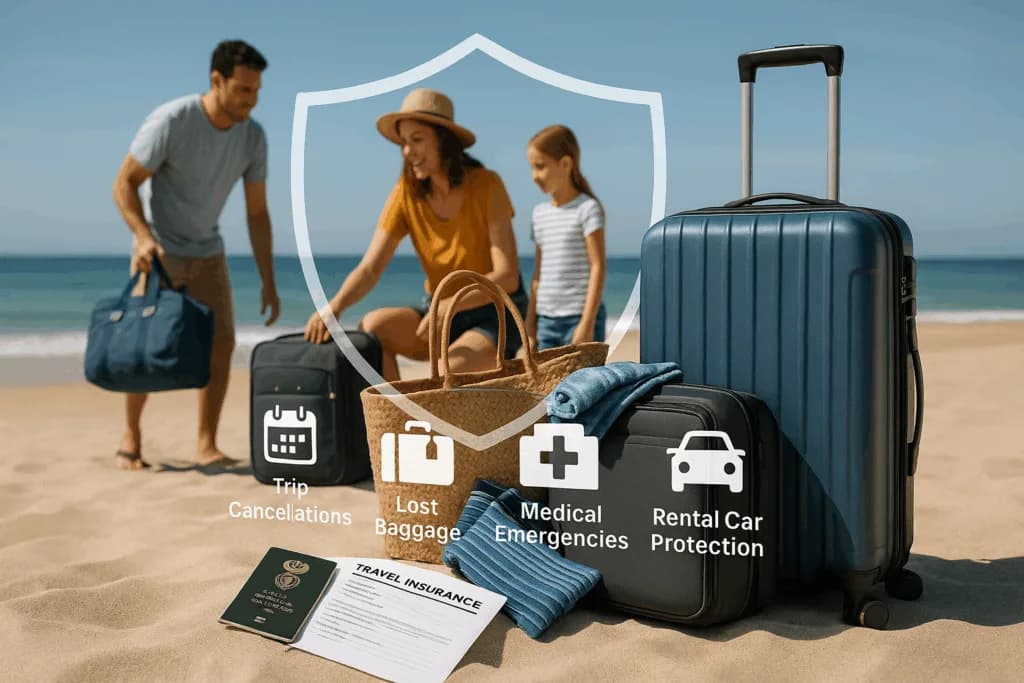
A beach holiday is supposed to lower blood pressure, not raise it. But luggage goes missing, flights get delayed, and sometimes food poisoning has the last laugh. Travel insurance fills the gap between your optimism and reality.
It’s not just for international trips. Domestic travellers can benefit too. Imagine your car breaks down halfway to Plett and your pre-paid accommodation laughs in cancellation fees. Or worse, your child ends up in a local clinic where your medical aid network doesn’t reach.
Comprehensive travel cover can include:
- Trip cancellations or delays.
- Lost or stolen baggage.
- Medical emergencies and evacuation.
- Rental car excess protection.
It’s the invisible safety net that lets you stop worrying and start braaing.
External references:Santam Holiday Insurance Guide Discovery Travel Insurance Overview
Festive Misunderstandings: The Fine Print You Forget
December optimism can make anyone reckless. You lend your car to a cousin “just for a quick trip.” You host a party where the neighbour’s toddler decides to test gravity near the pool. You buy expensive electronics on Black Friday but forget to update your household-contents list.
Insurance policies are very patient until you test them. Common festive-season exclusions include:
- Unlicensed or unlisted drivers behind the wheel.
- Leaving windows or doors unlocked.
- Not maintaining alarm systems or security devices.
- Neglecting to declare new valuables.
Before you assume “it’s fine,” read your policy. The fine print is less festive but far more forgiving when you understand it.
New Year, Same Wisdom: Review Before You Renew
December isn’t merely a time for braais and resolutions; it’s the perfect opportunity to audit your cover. Did you buy new tech this year? Renovate the kitchen? Add another car to the driveway? Your policy may still think you’re living last year’s life.
A quick end-of-year review keeps your cover aligned with reality. Check:
- Sum insured vs replacement values.
- Policy renewals or expiries due in January.
- Excess amounts you can afford.
Final Thoughts
Every December, we rush toward rest as if relaxation were a race. Yet the real peace comes from knowing the details are handled, the doors locked, the premiums paid, the fine print understood. Insurance might not sparkle like tinsel, but it keeps your Christmas intact when life drops the ball.
The festive season tests cover the rest of the year arranges, so the wider personal insurance behind it is worth a look before you pack.
A prang on the N3 in December tests more than nerves, and car hire cover decides whether the holiday continues on wheels.
You shouldn’t have to discover that your home policy lapsed mid-January, your rental car excess wasn’t covered, or your cousin wasn’t listed on your policy, after the fact. With Mont Blanc Financial Services you won’t.
Contact Mont Blanc Financial Services to review your car, home, and travel cover before the holiday season, and make sure the policy you have matches the December you’re actually planning.
This small task turns into one of the smartest gifts you can give yourself. Next year’s self will thank you. Give some thought to the following questions before you go.
Frequently Asked Questions
What insurance cover do South Africans need before the December holiday?
The December period creates three distinct insurance exposures that sit under separate policies and need to be checked independently before departure.The first is car insurance. South Africa’s roads carry their highest accident volumes during the festive season. Before a long road trip, confirm that all drivers who will use the vehicle are listed on the policy and hold valid licences. Check that roadside assistance, towing, and third-party cover are active. An unlisted driver behind the wheel: even for a short leg of the journey, is one of the most common grounds for a claim being rejected at a point when the financial exposure is at its highest.The second is home and contents insurance. An unoccupied house faces risks that an occupied one doesn’t: opportunistic break-ins, undetected water leaks, power surge damage from load-shedding, and fires that go unnoticed until they become structural damage. Check that theft cover applies during an absence, that electrical surge protection is in place, and that the policy’s vacancy clause won’t suspend cover partway through the holiday. Properties left empty for 30 days or more trigger vacancy conditions in most South African policies.The third is travel insurance. This applies to both international and domestic trips. Medical emergencies at destinations outside your medical aid’s hospital network, cancelled pre-paid accommodation, delayed or lost luggage, and rental car excess liability are all categories that standard medical aid and car insurance policies do not cover. Travel insurance fills those gaps, and for a December road trip with pre-paid bookings, it is worth the premium.
Does home insurance cover break-ins and damage while you’re on holiday in South Africa?
Home insurance covers burglary and malicious damage during a holiday absence, but the conditions that must be met are often more specific than policyholders assume, and vacancy clauses are the most common point of failure.Most South African home insurance policies include a clause that modifies or suspends certain cover if a property is left unoccupied beyond a specified period, typically 30 consecutive days. The rationale is straightforward: an empty property has no one to notice a leaking geyser, reset a tripped alarm, or report unusual activity to a neighbour. Insurers treat unoccupied properties as a higher risk and price or condition their policies accordingly.For shorter absences: the typical two-to-three-week December holiday, cover generally remains intact, provided the policyholder has met the policy’s security conditions. These commonly require that alarm systems are active and maintained, that doors and windows are secured with the locks specified in the policy, and that valuables are stored appropriately. A theft claim on a property where the alarm was offline due to a flat battery, or where an unlocked window was the point of entry, may be declined on these grounds regardless of the length of absence.The practical step before departure is to notify the insurer in writing of the absence dates, confirm the property meets all active security conditions, and arrange for someone to check in on the property if the absence approaches or exceeds 30 days. Insurers generally maintain full cover when these conditions are met. Non-notification, by contrast, removes the policyholder’s ability to argue they acted in good faith if a claim is later disputed.Is travel insurance worth it for domestic holidays in South Africa?Travel insurance is consistently undervalued for domestic trips because most South Africans associate it with international travel. The exposure it addresses, however, applies equally when the destination is Plettenberg Bay rather than Portugal.The medical gap is the most immediate. Medical aid schemes operate on hospital networks, and those networks are not uniformly available at domestic holiday destinations. A medical emergency at a private hospital outside your scheme’s contracted network can result in co-payments and shortfalls that a standard medical aid benefit does not cover. Travel insurance covers out-of-network treatment costs and, in serious cases, emergency evacuation to a facility that can provide appropriate care.The financial gap is equally real for pre-paid travel. Accommodation deposits, adventure activity bookings, and non-refundable transport arrangements represent money already spent that disappears if a trip is cancelled, cut short, or disrupted. Most consumer-facing cancellation policies in South Africa offer limited refunds on short notice, and the standard position is that the loss falls with the traveller. Travel insurance recovers these costs when the cancellation arises from a covered event: illness, accident, or a documented emergency.Rental car excess liability is a third exposure that domestic travellers frequently overlook. Rental companies in South Africa charge the full excess against the renter’s card in the event of any damage, regardless of fault. Travel insurance with a rental car excess waiver covers this liability up to the specified limit, removing the risk of a significant debit order arriving in January for an incident that wasn’t the traveller’s fault.
What insurance checks should South Africans do before the end of the year?
The end of the calendar year is the most practical moment to audit insurance cover, because the December break makes visible what a year of changes has left uncovered.The sum insured on a home contents policy should reflect the current replacement cost of what the property contains, not what it contained when the policy was last updated. Electronics purchased on Black Friday, jewellery received as gifts, renovations completed during the year, or new appliances installed since the last renewal all represent value that the existing policy may not cover. Items above a certain value typically need to be specified separately. If they aren’t listed, a claim for their loss or damage is limited to the unspecified all-risk sub-limit, which is frequently lower than the item’s actual value.Vehicle policy details should reflect current usage. A car used for business purposes that is insured under a personal-use policy carries a cover gap that may only surface at the point of claim. A second vehicle added to the household, or a change in the primary driver, requires a policy update.Policy renewal dates and excess amounts are worth confirming before January. A policy that renews automatically in January without review may retain terms that no longer match the insured’s risk profile, or that have changed at renewal without the policyholder reading the updated schedule. Excess amounts selected at inception may no longer reflect what the policyholder can realistically absorb in the event of a claim.A broker who reviews the full portfolio at year end: rather than processing renewals mechanically, identifies these gaps before they matter.

Nicola Iozzo
Founder & CEO, Mont Blanc Financial Services
Nicola has spent his career reading the policy wording most people skip, and writes here so you don't discover at claim stage what page 14 meant.
This blog is here to inform, not advise. Think of it as a guidebook, not a contract. For decisions affecting your world, have a chat with your broker or financial professional.
Mont Blanc Financial Services (PTY) Ltd. is an authorised financial services provider. FSP 8271